Download
1 / 21
210 likes | 364 Views
Learn about dividing polynomials using long division method and analyze the end behavior of polynomial functions such as linear and quadratic equations. Understand the impact of leading coefficient on graph behavior as x approaches positive and negative infinity. Investigate and graph various polynomial functions to determine end behavior based on degree and leading coefficient.

E N D
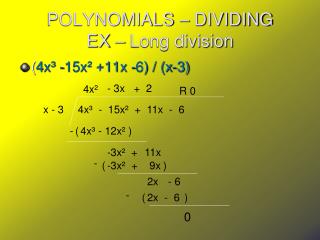
POLYNOMIALS – DIVIDINGEX – Long division (4x³ -15x² +11x -6) / (x-3) - 3x + 2 4x² R 0 x - 3 4x³ - 15x² + 11x - 6 - ( 4x³ - 12x² ) -3x² +11x - ( -3x² + 9x ) 2x - 6 - ( 2x - 6 ) 0
A function is odd if the degree which is greatest is odd and even if the degree which is greatest is even Example: even Example: odd
End Behavior • Behavior of the graph as x approaches positive infinity (+∞) or negative infinity (-∞) • The expression x→+∞ : as x approaches positive infinity • The expression x→-∞ : as x approaches negative infinity
End Behavior of Graphs of Linear Equations f(x) = x f(x) = -x f(x)→-∞ as x→+∞ f(x)→+∞ as x→-∞ f(x)→+∞ as x→+∞ f(x)→-∞ as x→-∞
End Behavior of Graphs of Quadratic Equations f(x) = x² f(x) = -x² f(x)→-∞ as x→+∞ f(x)→-∞ as x→-∞ f(x)→+∞ as x→+∞ f(x)→+∞ as x→-∞
End Behavior… • Four Possibilities • Up on both ends • Down on both ends • Up on the right & Down on the left • Up on the left & Down on the right
End Behavior… Four Prototypes: • Up on both ends… y = x2 • Down on both ends… y = -x2 • Up on the right & Down on the left… y = x3 • Up on the left & Down on the right… y = -x3
End Behavior… Notation: • Up on both ends… • Down on both ends… • Up on the right & Down on the left… • Up on the left & Down on the right…
Investigating Graphs of Polynomial Functions • Use a Graphing Calculator to grph each function then analyze the functions end behavior by filling in this statement: f(x)→__∞ as x→+∞ and f(x)→__∞ as x→-∞ a. f(x) = x³ c. f(x) = x4 e. f(x) = x5 g. f(x) = x6 b. f(x) = -x³ d. f(x) = -x4 f. f(x) = -x5 h. f(x) = -x6
Investigating Graphs of Polynomial Functions • How does the sign of the leading coefficient affect the behavior of the polynomial function graph as x→+∞? • How is the behavior of a polynomial functions graph as x→+∞ related to its behavior as x→-∞ when the functions degree is odd? When it is even?
Using the Leading Coefficient to Describe End Behavior: Degree is EVEN • If the degree of the polynomial is even and the leading coefficient is positive, both ends ______________. • If the degree of the polynomial is even and the leading coefficient is negative, both ends ________________.
Using the Leading Coefficient to Describe End Behavior: Degree is ODD • If the degree of the polynomial is odd and the leading coefficient is positive, the graph falls to the __________ and rises to the ______________. • If the degree of the polynomial is odd and the leading coefficient is negative, the graph rises to the _________ and falls to the _______________.
Determining End Behavior Match each function with its graph. B. A. C. D.
When you transform a function Inside the parentheses translates left and right Outside the parentheses translates up and down
Graphing Polynomial Functions f(x)= -x4 –2x³ + 2x² + 4x
Many correct answers For example, there are an infinite number of polynomials of degree 3 whose zeros are -4, -2, and 3. They can be expressed in the form: