Download
1 / 18
190 likes | 317 Views
Bellamare, LLC, alongside Traklogik, is pioneering an innovative In-Situ Plankton Imaging System designed to provide high-resolution imaging of plankton in their natural habitats. With a focus on minimizing organism disturbance and improving data collection accuracy, our system captures large water volumes, enabling detailed spatial and vertical distribution studies. The technology aids in monitoring environmental changes and assessing fish populations. Our ongoing developments aim for smaller, cost-effective systems that will enhance research capabilities in marine biology and environmental monitoring.

E N D
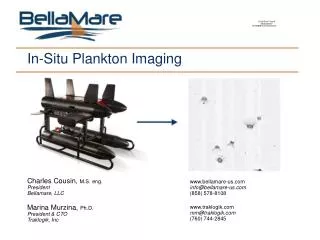
In-Situ PlanktonImaging Charles Cousin, M.S. eng. President Bellamare, LLC www.bellamare-us.com info@bellamare-us.com (858) 578-8108 www.traklogik.com mm@traklogik.com (760) 744-2845 Marina Murzina, Ph.D. President & CTO Traklogik, Inc
Founded in 2006 to provide engineering services to the University of Miami Marine Biology Department The goal was to design/manufacture a:“In-Situ Plankton Imaging System” Already Two Major Achievements:Innovative Imaging System & Innovative ROTVs Future Developments- Need forless expensive,smaller systems-Skids to Rosette CTD, Hand Deployable Tow Fish, Smaller ROTVs
The Need Replace / Complement Net Systems Hard work & lots of microscope time… 2 days at sea = 1 man-year of microscope work!
Our Solution • Imaging is a great solution • Precise location position and time of each organism • Inform about spatial and vertical distribution of critters (fine-scale distributions of plankton from centimeter- to basin- wide volumes) • Environmental data of the organisms’ surroundings are sampled in sync. • Imaging does not destroy organisms - easier to recognize! Imaging “LARGE VOLUME OF WATER” (comparable to net tows)Less abundant taxa is missed when imaging too small of a volume
Our Images Imaging tiny organisms at 5 knots…
Our Images ISIIS uses a line-scan camera. It creates one single CONTINUOUS image representing a real “slice” of the ocean. When put end to end, images recorded represent one continuous image, several kilometers long, matching the mission profile.
Plankton! Why? • Plankton is the bottom of the ocean’sFood Chain (No plankton, no fish, no whales….). It is also a very important part of theCarbon Cycle. • Climate Change / Pollution:since plankton is not harvested or exploited by humans, adjustments in distribution and abundance can be attributed to changing environmental factors. • Fish Stocks:the abundance of eggs and larvae is a scientific indicator of population abundance of adults. Applications Fundamental Science High Frequency Monitoring of Fish Population Coastal Construction Permitting / Environmental Monitoring
If high data analysis of collected images is feasible, we can increasesampling frequency which leads to better monitoring and leads to a greater capacity for improved scientific inquiries. Automated Analysis is a Must!
Automated Image Analysis Recognizing Plankton Creatures Generally, there are 2 necessary steps for pattern recognition: Step 1. Segmentation : find regions/objects of interest (ROI-s) versus background. Step 2. Recognition : identify objects of interest as belonging to certain classes. Copepod Solmaris Appendicularian
typical zooscan image typical VPR image: focal plane Step 1. Segmentationfor In-Situ High-Volume Imaging Challenges: Compared to Lab Imaging scanners (net tows “Zooscan”), our background is real ocean water: - Non-uniform intensity distribution- Bubbles- Unrelated objects. Compared to other In-Situ Imagers, we look at BIG water VOLUMES: - Focus quality will vary! our system: VOLUME
Step 1. Segmentation…Continued Original Mask Show Regions of Interest (ROIs) PROPRIETARY SEGMENTATION ALGORITHM
segmentation “Segmentator” A Powerful Tool in Itself 1. Data Reduction > 20 times. 2. Can be implemented on parallel hardware for real-time, on board, processing. 3. Number of ROIs and their distribution, by size, are already very informative! Regions of Interest: 57 MB Total original 300 Frames: 1.17 GB Total
AnotherSegmentation Example Original Mask SEGMENTATION ALGORITHM Further recognition must be adapted to non-perfect ROIs such as “group portraits” .
Step 2. Recognition Manual training Recognition Done manually, here, for “Training” purposes
Step 2. Recognition Ambiguities can be numerous… Need to adapt Recognition to the imaging system’s resolution:Smaller, more abundant taxa should be imaged with a secondary system to avoid ambiguities. Radiolarian type II Jelly tiny 1mm Chaetognath Appendicularian Shrimps Fish
Step 2. Recognition Known efforts… • Known Plankton Recognition Approaches • G. Tsechpenakis, C. Guigand, and R. Cowen, "Image analysis techniques to accompany a new In Situ Ichthyoplankton Imaging System (ISIIS)", 2007. • Q.Hu, C. Davis, “Accurate automatic quantification of taxa-specific plankton abundance using dual classification with correction”, Marine Ecology Progress Series, 306: 51–61, 2006 Calculate 30+ features!! size, aspect ratio, Hu moments, Fourier Coeffs for contour Radius(Angle), texture-based values (mean and range of co-occurrence matrices from different angles, energy, contrast, entropy, etc.) and a support vector machine classifier. With extensive variety of plankton shapes, and potentially non-perfect ROIs (segmentation), generalization methods of recognition face a big challenge. Our Approach is different…
Incoming(unknown) vector is broadcasted to all neurons simultaneously No Limit Step 2. Recognition Our Vision Our Approach combines: 1) Proprietary analytical methods whenever there is a distinct recognition principle, like “triangular” copepods. (includes integrating logical reasoning into distance equation in clustering space as logical polynomials) 2) CogniMem: dedicated hardware NN non-linear classifier: learn and recognize a 256-bytes vector < 11μsec @27MHz. Publication on these results is coming...