Discovering Benjamin Franklin: Inventions, Discoveries, and Creative Problem Solving
190 likes | 302 Views
In this engaging lesson, students explore Benjamin Franklin's life and contributions through a variety of interactive activities. Beginning with a brainstorming session, they read "Now & Ben" and create circle maps detailing Franklin's inventions and discoveries. The class distinguishes between inventions and discoveries before collaboratively constructing a tree map. In small groups, students brainstorm problems and design their inventions, ultimately building and testing their ideas. The lesson concludes with students reflecting on their inventions, sharing findings, and crafting cinquain poems to express their learning.


Discovering Benjamin Franklin: Inventions, Discoveries, and Creative Problem Solving
E N D
Presentation Transcript
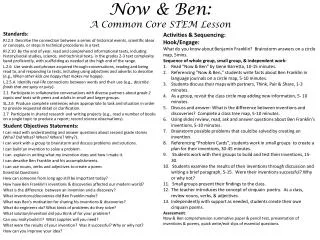
Activities & Sequencing: Hook/Engage: What do you know about Benjamin Franklin? Brainstorm answers on a circle map, 5mins. Sequence of whole group, small group, & independent work: Read “Now & Ben” by Gene Barretta, 10-15 minutes. Referencing “Now & Ben,” students write facts about Ben Franklin in language journals on a circle map, 5-10 minutes. Students discuss their maps with partners, Think, Pair & Share, 1-3 minutes. As a group, revisit the class circle map adding new information, 5- 10 minutes. Discuss and answer: What is the difference between inventions and discoveries? Complete a class tree map, 5-10 minutes. Using slides review, read, ask and answer questions about Ben Franklin’s inventions, 5-10 minutes. Brainstorm possible problems that could be solved by creating an invention. Referencing “Problem Cards”, students work in small groups to create a plan for their inventions, 30-45 minutes. Students work with their groups to build and test their inventions, 15-30. Students examine the results of their inventions through discussion and writing a brief paragraph, 5-15. Were their inventions successful? Why or why not? Small groups present their findings to the class. The teacher introduces the concept of cinquain poetry. As a class, review nouns, verbs, & adjectives. Independently with support as needed, students create their own cinquainpoems. Assessment: Now & Ben comprehension summative paper & pencil test, presentation of inventions & poems, quick write/exit slips of essential questions. Now & Ben: A Common Core STEM Lesson Standards: RI.2.3 Describe the connection between a series of historical events, scientific ideas or concepts, or steps in technical procedures in a text. RI.2.10 By the end of year, read and comprehend informational texts, including history/social studies, science, and technical texts, in the grades 2-3 text complexity band proficiently, with scaffolding as needed at the high end of the range. L.2.6 Use words and phrases acquired through conversations, reading and being read to, and responding to texts, including using adjectives and adverbs to describe (e.g., When other kids are happy that makes me happy). L.2.5.A Identify real-life connections between words and their use (e.g., describe foods that are spicy or juicy). 2.1 Participate in collaborative conversations with diverse partners about grade 2 topics and texts with peers and adults in small and larger groups. SL.2.6 Produce complete sentences when appropriate to task and situation in order to provide requested detail or clarification. 2.7 Participate in shared research and writing projects (e.g., read a number of books on a single topic to produce a report; record science observations). Student Objectives Statements: I can read with understanding and answer questions about second grade stories (Who? Did What? When? Where? Why?). I can work with a group to brainstorm and discuss problems and solutions. I can build an invention to solve a problem. I can explain in writing what my invention does and how I made it. I can describe Ben Franklin and his accomplishments. I can use nouns, verbs and adjectives to create a poem. Essential Questions: How can someone from long ago still be important today? How have Ben Franklin’s inventions & discoveries affected our modern world? What is the difference between an invention and a discovery? What inventions/discoveries did Ben Franklin make? What was Ben’s motivation for sharing his inventions & discoveries? What do engineers do? What kinds of problems do they solve? What solution/invention did you think of for your problem? Can you really build it? What supplies will you need? What were the results of your invention? Was it successful? Why or why not? How can you improve your idea?
At the time of his death in 1790, when more than 5,000 of them had been built, Ben Franklin had collected no money from his glass armonica. He refused to patent any of his inventions, saying: "As we enjoy great Advantages from the Inventions of others we should be glad of an Opportunity to serve others by any Invention of ours, and this we should do freely and generously." Ben certainly gave freely and generously, constantly investing time and energy to make his ideas a useful or entertaining reality.
Lightning Rod How it works… Original Modern
Let’s review what we already know… Man sister run pretty teacher red fancy boy famous create walk five doctor think
Assignment: Use what you have learned about Ben Franklin and write your own Cinquainpoem. Be ready to share your poem when you are finished. Let's start by making a list of nouns, verbs, and adjectives.