Overview of Invertebrate Classification: Parazoa and Eumetazoa Regions
This document provides a comprehensive overview of invertebrate classification, focusing on the two subkingdoms: Parazoa and Eumetazoa. Parazoa includes multicellular organisms like sponges, characterized by less specialized cells and the ability to reproduce both sexually and asexually. Eumetazoa features animals with true tissues, showcasing the evolutionary transition to distinct body plans, including worms and jellyfish. The text also covers Acoelomates, Pseudocoelomates, Annelida, Mollusca, Anthropoda, and Echinodermata, detailing their biological significance.

Overview of Invertebrate Classification: Parazoa and Eumetazoa Regions
E N D
Presentation Transcript
Group E: Invertebrates BY: James Lentz, Nile Jones, Hector Ponce, Diego Gutierrez
Table of Contents • Parazoa, Eumetazoa (Hector Ponce, Diego Gutierrez) • Acoelomates, Pseudocoelomates, Annelida (James Lentz) • Mollusca, Anthropoda, Echinodermata (Nile Jones)
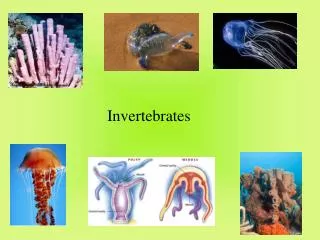
Parazoa • Animal subkingdom that includes sponges • Multicellular organisms having less-specialized cells than in the Metazoa • They can reproduce sexually and asexually • Sponges contain 3 layers mesohyl, spicules, spongin
Eumetazoa • Animals with true tissues • Contains animals that evolved the first key transition in the animal body plan: distinct tissues • Worms, jellyfish,etc.