Innovative Conductive Oxide Coatings for Affordable Intermediate-Temperature SOFC Applications
This research explores new metallic alloys intended for the development of conductive oxide coatings on metallic interconnects in solid oxide fuel cells (SOFCs). By improving oxidation resistance and reducing area specific resistance (ASR), these alloys, particularly SFA-11, aim to enhance the efficiency of SOFCs while lowering costs, thereby facilitating market entry. The study includes educational outreach initiatives where high school students engage in hands-on fuel cell projects, showcasing the practical applications of advanced materials in energy technology.

Innovative Conductive Oxide Coatings for Affordable Intermediate-Temperature SOFC Applications
E N D
Presentation Transcript
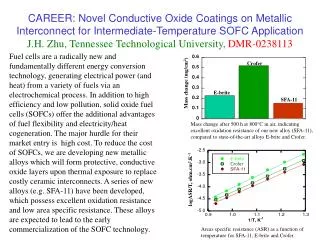
Crofer Mass change (mg/cm2) E-brite SFA-11 logASR/T, ohm.cm2.K-1 CAREER: Novel Conductive Oxide Coatings on Metallic Interconnect for Intermediate-Temperature SOFC ApplicationJ.H. Zhu, Tennessee Technological University, DMR-0238113 Fuel cells are a radically new and fundamentally different energy conversion technology, generating electrical power (and heat) from a variety of fuels via an electrochemical process. In addition to high efficiency and low pollution, solid oxide fuel cells (SOFCs) offer the additional advantages of fuel flexibility and electricity/heat cogeneration. The major hurdle for their market entry is high cost. To reduce the cost of SOFCs, we are developing new metallic alloys which will form protective, conductive oxide layers upon thermal exposure to replace costly ceramic interconnects. A series of new alloys (e.g. SFA-11) have been developed, which possess excellent oxidation resistance and low area specific resistance. These alloys are expected to lead to the early commercialization of the SOFC technology. Mass change after 500 h at 800C in air, indicating excellent oxidation resistance of our new alloy (SFA-11), compared to state-of-the-art alloys E-brite and Crofer. Areas specific resistance (ASR) as a function of temperature for SFA-11, E-brite and Crofer.
High school students testing a fuel cell module that they built during the camp CAREER: Novel Conductive Oxide Coatings on Metallic Interconnect for Intermediate-Temperature SOFC Application”J.H. Zhu, Tennessee Technological University, DMR-0238113 Educational Outreach: PI organized a Fuel Cells and Advanced MaterialsCamp in June, 2004 for local high school students and their science teachers. Three teams comprising three students and one teacher from 3 local high schools attended the three-day camp. Camp activities included: • Lectures and demonstrations on the operation principles of fuel cells; • Hands-on construction/testing of fuel cell modules; • Data analysis, report writing, and competition between the three teams; • Field trip to Oak Ridge National Laboratory and National Transportation Research Center Two high-school students (Christian Brown and Dragan Idem) received the First Prize at the TTU Science Fair for their fuel cell project conducted at the PI’s lab. Data analysis and report writing