Understanding Minerals: Definition, Formation, and Classification**
Minerals are naturally occurring, inorganic compounds or elements with a definite chemical composition and crystalline structure. The study of minerals encompasses their formation, classification based on physical and chemical properties, and their diverse roles in human history and industry. Early humans used minerals like hematite and ochre for pigment, while modern applications range from gypsum in drywalls to halite for table salt. This guide explores the characteristics of minerals, including their unique compositions and the processes leading to their formation from magma and solutions.

Understanding Minerals: Definition, Formation, and Classification**
E N D
Presentation Transcript
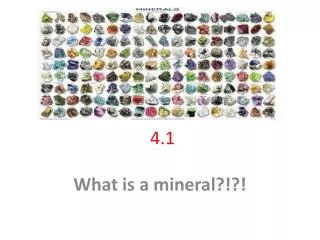
4.1 What is a mineral?!?!
Objectives for 4.1 • Define a mineral • Describe how minerals form • Classify minerals according to their physical and chemical properties Main idea: Minerals are naturally occurring, , inorganic compounds or elements with a definite chemical compostionand ___________________
Little side note on minerals • Early humans painted on rock walls made from red & yellow pigments in soils (hematite & ochre) • Countries have fought wars and trade companies battled over deposits of table salt (halite) • Today, we build our houses out of dry wall (gypsum), cement out of lime (calcite), and extract aluminum from bauxite to make aluminum foil and soda cans I FEEL MY IGNORANCE DEPLETING!!
Mineral Characteristics • Earth’s crust:
Mineral Characteristics • Naturally occurring: • Inorganic: • Definite chemical composition: each mineral has unique chemical composition to identify itself • Salt or Halite (NaCl) • Muscovite (KAl2(AlSi3O10)(OH)2) • Graphite ( C )
Mineral Characteristics • Definite crystalline structure:
Rock-Forming Minerals • _______ of the 30 most common minerals • Primarily composed of the ____ most common elements in the Earth’s crust • Oxygen (46.6 %) • Silicon (27.7%) • Aluminum (8.1 %) • Iron (5%) • Calcium (3.6 %) • Sulfur (2.8%) • Potassium (2.6 %) • Magnesium (2.1 %) • Other (1.5%)
Minerals from magma • What is magma? • Density of magma: • What minerals form from magma are based on 2 things: Rate at which magma cools is important
Minerals from solutions • Saturated solution: • Supersaturated solution: