Understanding Hot Galactic ISM and Solutions to Over-cooling Problems in Galaxy Formation
250 likes | 374 Views
This study explores the characteristics and dynamics of the hot interstellar medium (HISM) in nearby galaxies, revealing no significant X-ray absorption beyond the LMC and a thick Galactic disk with a scale height of 1-2 kpc. Key findings include a solar or higher oxygen abundance, mean temperatures around 10^6 K, and a high volume filling factor. The paper discusses the missing energy and metal contributions due to stellar feedback mechanisms, primarily Type Ia supernovae, and presents models for understanding the heating and cooling processes in the Galactic bulge, which may provide solutions to the over-cooling problem in galaxy formation.


Understanding Hot Galactic ISM and Solutions to Over-cooling Problems in Galaxy Formation
E N D
Presentation Transcript
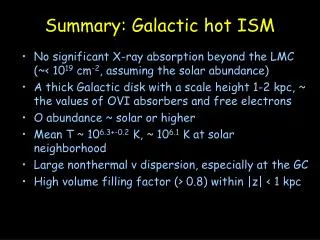
Summary: Galactic hot ISM • No significant X-ray absorption beyond the LMC (~< 1019 cm-2, assuming the solar abundance) • A thick Galactic disk with a scale height 1-2 kpc, ~ the values of OVI absorbers and free electrons • O abundance ~ solar or higher • Mean T ~ 106.3+-0.2 K, ~ 106.1 K at solar neighborhood • Large nonthermal v dispersion, especially at the GC • High volume filling factor (> 0.8) within |z| < 1 kpc
Missing Energy” and “Over-cooling” Problems in Galaxies and Possible Solutions
External Perspective: NGC 3556 (Sc) • Active star forming • Hot gas scale height ~ 2 kpc • Lx ~ 1% of SN mech. Energy input Red – optical Green – 0.3-1.5 keV band Blue – 1.5-7 keV band Wang et al. 2004
NGC 2841 (Sb) Red: optical Blue: 0.3-1.5 keV diffuse emission
Wang (2004) Red – optical Green – 0.3-1.5 keV band Blue – 1.5-7 keV band NGC 4565 (Sb) Very low specific SFR No sign for any outflows from the disk in radio and optical William McLaughlin (ARGO Cooperative Observatory)
NGC 4594 (Sa) H ring Red: optical Green: 0.3-1.5 keV Blue: 1.5-7 keV
NGC 4631 NGC 4594:X-ray spectra Point source disk Outer bulge • Average T ~ 6 x 10⁶ K • Strong Fe –L complex • Lx ~ 4 x 1039 erg/s, or ~ 2% of the energy input from Type Ia SNe alone • Not much cool gas to hide or convert the SN energy • Mass and metals are also missing! • Mass input rate of evolved stars • ~ 1.3 Msun/yr • Each Type Ia SN 0.7 Msun Fe Inner bulge
Galaxy formation simulations vs. observations NGC 4594 NGC 4565 NGC 4594 NGC 4565 Toft et al. (2003)
No evidence for large-scale X-ray-emitting galactic halos Li et al. (2006)
Summary: Nearby galaxies • Good News • At least two components of diffuse hot gas: • Disk – driven by massive star formation • Bulge – heated primarily by Type-Ia SNe • Characteristic extent and temperature similar to the Galactic values • Bad news • Missing stellar feedback, at least in early-type spirals. • Little evidence for X-ray emission or absorption from IGM accretion --- maybe good news for solving the over-cooling problem. Are these problems related?
Feedback • Radiation • AGNs • Supernovae • Core-collapsed SNe • Type 1a
Bulge wind model • Spherical, steady, and adiabatic • NFW Dark matter halo + stellar bulge • Energy and mass input follows the stellar light distribution • CIE plasma emission • Implemented in XSPEC for both projected spectral and radial surface brightness analyses Li & Wang 2006
Data vs model Consistent with the expected total mass loss and SN rates as well as the Fe abundance of ~ 4 x solar!
The best-fit model density and temperature profiles of the bulge wind
3-D hydro simulations • Goals • To characterize the density, temperature, and metal abundance structures, the heating and cooling processes, and the kinematics of the HISM • To calibrate the 1-D model • Hydro simulations with metal particle tracers • Parallel, adaptive mesh refinement FLASH code • Whole galactic bulge simulation with the finest refinement in one octant down to 6 pc • Stellar mass injection and SNe, following stellar light • Realistic gravitational potential of the bulge and the dark matter halo
Galactic bulge simulation: density • 3x3x3 kpc3 box • SN rate ~ 4x10⁻⁴ /yr • Mass injection rate ~0.03 Msun/yr • Logarithmic scale • Statistical steady state • ~ adiabatic Tang et al. 2005
ROSAT X-ray All-sky Survey Red – 1/4 keV band Green – 3/4 keV band Blue – 1.5 keV band
Conclusions and implications • Large inhomogeneity is expected • particularly in the hot Fe distribution • enhanced emission at both low and high temperatures (compared to the 1-D solution) • SNe generate waves in the HISM • Energy not dissipated locally or in swept-up shells • Maybe eventually damped by cool gas or in the galactic hot halo • Galactic wind not necessary • Possible solution to the over-cooling problem of galaxy formation
Galactic bulge simulation: Fe • Fe-rich ejecta dominate the high-T emission • Not well-mixed with the ambient medium • May cool too fast to be mixed with the global hot ISM
Non-uniformity effects High Res. 1-D Low Res. 1-D Log(T(K))