
Dynamic Routing Protocols
E N D
Presentation Transcript
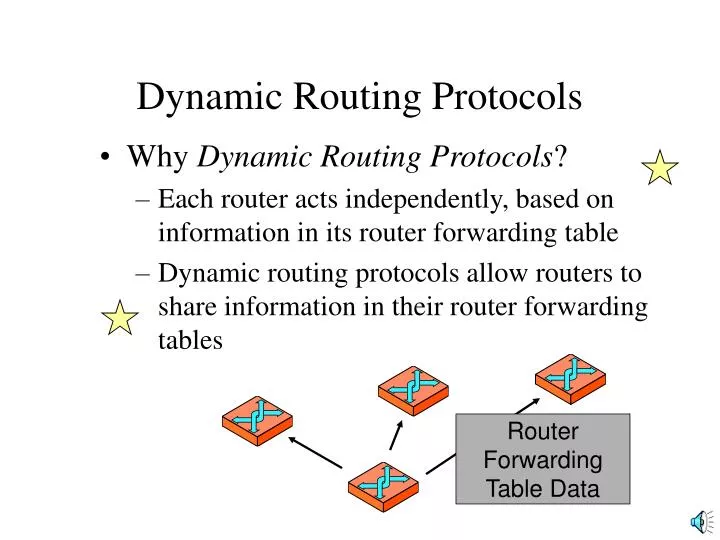
Dynamic Routing Protocols • Why Dynamic Routing Protocols? • Each router acts independently, based on information in its router forwarding table • Dynamic routing protocols allow routers to share information in their router forwarding tables Router Forwarding Table Data
Routing Information Protocol (RIP) • Routing Information protocol (RIP) is the simplest dynamic routing protocol • Each router broadcasts its entire routing table frequently • Broadcasting makes RIP unsuitable for large networks Routing Table
Routing Information Protocol (RIP) • RIP is the simplest dynamic routing protocol • Broadcasts go to hosts as well as to routers • RIP interrupts hosts frequently, slowing them down; Unsuitable for large networks Routing Table
Routing Information Protocol (RIP) • RIP is Limited • RIP routing table has a field to indicate the number of router hops to a distant host • The RIP maximum is 15 hops • Farther networks are ignored • Unsuitable for very large networks Hop Hop
Routing Information Protocol • Is a Distance Vector Protocol • “New York” starts, announces itself with a RIP broadcast • “Chicago” learns that New York is one hop away • Passes this on in its broadcasts NY is 1 New York Chicago Dallas 1 hop
Routing Information Protocol • Learning Routing Information • “Dallas” receives broadcast from Chicago • Already knows “Chicago” is one hop from Dallas • So New York must be two hops from Dallas • Places this information in its routing table NY is 1 New York Chicago Dallas 1 hop 1 hop NY is 2
Routing Information Protocol • Slow Convergence • Convergence is getting correct routing tables after a failure in a router or link • RIP converges very slowly • May take minutes • During that time, many packets may be lost
Routing Information Protocol • Encapsulation • Carried in data field of UDP datagram • Port number is 520 • UDP is unreliable, so RIP messages do not always get through • A single lost RIP message does little or no harm UDP Data Field RIP Message UDP Header
OSPF Routing Protocol • Link State Protocol • Link is connection between two routers • OSPF routing table stores more information about each link than just its hop count: cost, reliability, etc. • Allows OSPF routers to optimize routing based on these variables Link
OSPF Routers • Network is Divided into Areas • Each area has a designated router Area Designated Router
OSPF Routers • When a router senses a link state change • Sends this information to the designated router Area Designated Router Notice of Link State Change
OSPF Routers • Designed Router Notifies all Routers • Within its area Area Designated Router Notice of Link State Change
OSPF Routers • Efficient • Only routers are informed (not hosts) • Usually only updates are transmitted, not whole tables Area Designated Router Notice of Link State Change
OSPF • Fast Convergence • When a failure occurs, a router transmits the notice to the designated router • Designated router send the information back out to other routers immediately
OSPF • Encapsulation • Carried in data field of IP packet • Protocol value is 89 • IP is unreliable, so OSPF messages do not always get through • A single lost OSPF message does little or no harm IP Data Field OSPF Message IP Header
Selecting RIP or OSPF • Within a network you control, it is your choice • Your network is an autonomous system • Select RIP or OSPF based on your needs • Interior routing protocol
Selecting RIP or OSPF • RIP is fine for small networks • Easy to implementing • 15 hops is not a problem • Broadcasting, interrupting hosts are not too important
Selecting RIP or OSPF • OSPF is Scalable • Works with networks of any size • Management complexities are worth the cost in large networks
Border Gateway Protocol (BGP) • To connect different autonomous systems • Must standardize cross-system routing information exchanges • BGP is most popular today • Gateway is the old name for router • Exterior routing protocol Autonomous System Autonomous System BGP
Border Gateway Protocol (BGP) • Distance vector approach • Number of hops to a distant system is stored in the router forwarding table • Normally only sends updates Autonomous System Autonomous System BGP
Border Gateway Protocol (BGP) • Encapsulation • BGP uses TCP for delivery • Reliable • TCP is only for one-to-one connections • If have several external routers, must establish a TCP and BGP connection to each Autonomous System Autonomous System BGP