The Qin and Han Dynasties: Foundations of a Unified China and the Birth of Confucianism
The Qin Dynasty (221-206 BCE) marked the end of the Warring States Period through the unification of China by Shihuangdi, who established lasting systems of governance, standardized measurements, and initiated the Great Wall. Influenced by Legalism, his regime emphasized strict laws to maintain order. Following the Qin, Confucianism emerged, focusing on social stability and ethical governance. It highlighted the importance of rituals, humaneness, and defined relationships, shaping future dynasties and continuing through the civil examination system until 1905.

The Qin and Han Dynasties: Foundations of a Unified China and the Birth of Confucianism
E N D
Presentation Transcript
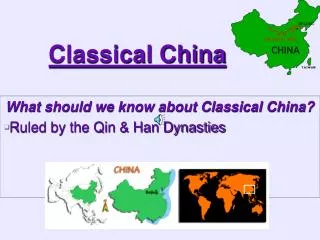
Classical China Qin and Han Dynasties
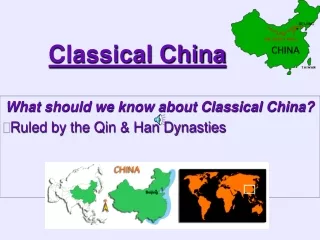
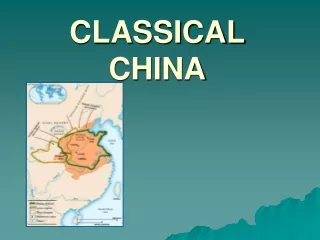
The Qin Dynasty 221-206 • Emerged from the Warring States Period (475 BCE to 221BCE) • Shihuangdi reunited China • He laid the foundation for a unified Chinese state that has endured to the present. • He started the Great Wall of China • Uniform tax, weights, and measurement systems • Standardized the written form of the Chinese language
Political Organization • Legalism – A reaction to the disorder of the Warring States Period • Developed by Han Fei • Strict set of laws that spelled out punishments and rewards • Humans are naturally bad and only obey authority through force • Future dynasties were influenced by this focus on the importance of laws
Questions to Answer • On the back page of your last notes • What kind of logistical efforts were required to produce such a ceramic army? • Based on these visual sources, and what Codega has told you about the tomb complex, how would you characterize Shihuangdi as a leader?
China before Confucius • Xia and Shang Dynasties • 2070 B.C. - 1046 B.C. • Zhou Dynasty • 1046 B.C. - 256 B.C.
Confucius • Born in 551 B.C. • died in 479 B.C.
Confucianism • Concerned primarily with restoring social stability and order • What is the basis of a stable, unified, and enduring social order? • a system of social and ethical philosophy • “only when character is cultivated are our families regulated; only when families are regulated are states well governed.”
Confucianism • li • rituals, norms, institutions, or mores • the outer, conforming aspect of Confucianism • ren • humaneness, love, kindness, benevolence, or virtue • the inner, reforming aspect of Confucianism
Li • Rites, ceremonies, proper behavior, and good manner • performed in good faith, with everyone keeping to his or her proper role • universal harmony • no need for physical sanctions, laws, or punishment
Ren • Relationship between "two persons” • extension of filial piety (respect for parents and ancestors) to all human beings • each role in the hierarchy of social relations had clearly defined duties • reciprocity or mutual responsibility
Five relationships • father-child • ruler-subject • husband-wife • elder brother-younger brother • friend-friend
Confucianism • Persecuted in Qin Dynasty • 221 B.C. - 206 B.C. • promoted by later rulers
Confucianism • reinforced by the civil examination system • “keju”: civil examination • from 605 to 1905
Questions For Rome and the Han • What type of Imperial Institutions did they use to organize/control their subjects? • How did these empires project military power over large areas? • What was the social structure of the empire? • How did social tensions and/or environmental damage (internal pressure) lead to the decline of the empire? • What external pressures led to the decline of the empire?