Advanced Approaches to Sequence Analysis in Data Optimization
210 likes | 299 Views
Explore cutting-edge techniques such as Parsimony, similarity, and optimization in sequence analysis for effective data handling and analysis. Understand the TKF91 process and acceleration of basic algorithms for advanced results.


Advanced Approaches to Sequence Analysis in Data Optimization
E N D
Presentation Transcript
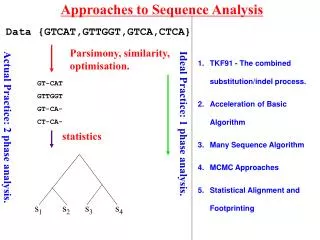
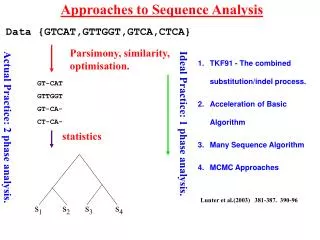
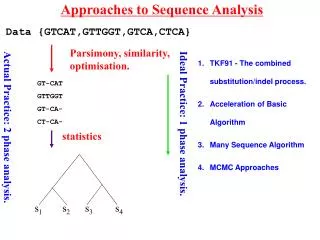
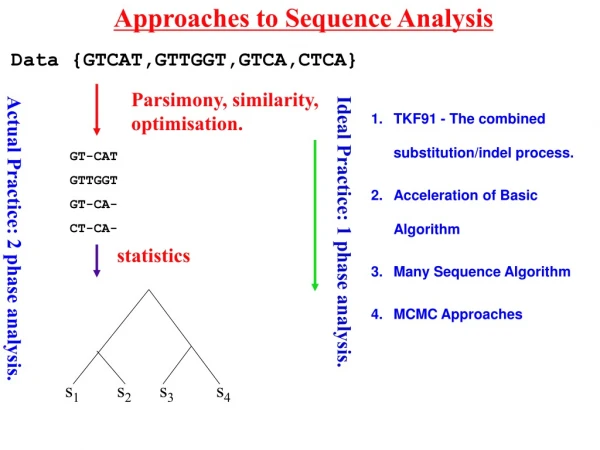
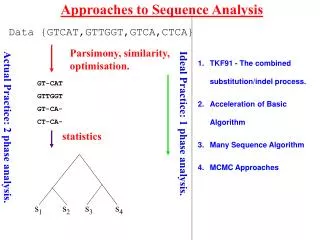
Approaches to Sequence Analysis s1 s2 s3 s4 Data {GTCAT,GTTGGT,GTCA,CTCA} Parsimony, similarity, optimisation. TKF91 - The combined substitution/indel process. Acceleration of Basic Algorithm Many Sequence Algorithm MCMC Approaches GT-CAT GTTGGT GT-CA- CT-CA- Ideal Practice: 1 phase analysis. Actual Practice: 2 phase analysis. statistics
Thorne-Kishino-Felsenstein (1991) Process * A # C G T= 0 # - - - ## # # # T = t # # # # • (birth rate) < m(death rate) 1. P(s) = (1-l/m)(l/m)l pA#A* .. *pT #T l =length(s) s1 r 2. Time reversible: s2 s1 s2 s1 s2
l & m into Alignment Blocks A. Amino Acids Ignored: # - - - # - - - - * - - - - ## # # - # # # # * # # # # k k k e-mt[1-lb(t)](lb(t))k-1 [1-e-mt-mb(t)][1-lb(t)](lb(t))k-1 [1-lb(t)](lb(t))k pk(t) p’k(t) p’’k(t) p’0(t)= mb(t) b(t)=[1-e(l-m)t]/[m-l] B. Amino Acids Considered: T - - - RQ S W Pt(T-->R)*pQ*..*pW*p4(t) 4 T - - - - - R Q S WpR *pQ*..*pW*p’4(t)
Diff. Equations for p-functions # - - ... - # # # ... # Dpk = Dt*[l*(k-1) pk-1 + m*k*pk+1 - (l+m)*k*pk] # - - - ... - - # # # ... # Dp’k=Dt*[l*(k-1) p’k-1+m*(k+1)*p’k+1-(l+m)*k*p’k+m*pk+1] * - - - ... - * # # # ... # Dp’’k=Dt*[l*k*p’’k-1+m*(k-1)*p’’k+1-((k+1)l+mk)*p’’k] Initial Conditions: pk(0)= pk’’(0)= p’k (0)= 0 k>1 p0(0)= p0’’(0)= 1. p’0 (0)= 0
Basic Pairwise Recursion (O(length3)) i i-1 j j-1 i j Survives: Dies: i-1 i i-1 i j-1 j j i-1 i j-2 j …………………… …………………… …………………… …………………… …………………… …………………… 1… j (j) cases 0… j (j+1) cases
survive death Basic Pairwise Recursion (O(length3)) j (i,j) (i-1,j) j-1 (i-1,j-1) Initial condition: p’’=s2[1:j] ………….. (i-1,j-k) ………….. ………….. i-1 i
Accelleration of Pairwise Algorithm (From Hein,Wiuf,Knudsen,Moeller & Wiebling 2000) Corner Cutting ~100-1000 Better Numerical Search ~10-100 Ex.: good start guess, 28 evaluations, 3 iterations Simpler Recursion ~3-10 Faster Computers ~250 1991-->2000 ~106
a-globin (141) and b-globin (146) (From Hein,Wiuf,Knudsen,Moeller & Wiebling 2000) 430.108 : -log(a-globin) 327.320 : -log(a-globin -->b-globin) 730.428 : -log(a-globin, b-globin) = -log(l(sumalign)) l*t: 0.0371805 +/- 0.0135899 m*t: 0.0374396 +/- 0.0136846 s*t: 0.91701 +/- 0.119556 E(Length) E(Insertions,Deletions) E(Substitutions) 143.499 5.37255 131.59 Maximum contributing alignment: V-LSPADKTNVKAAWGKVGAHAGEYGAEALERMFLSFPTTKTYFPHF-DLS--H---GSAQVKGHGKKVADALT VHLTPEEKSAVTALWGKV--NVDEVGGEALGRLLVVYPWTQRFFESFGDLSTPDAVMGNPKVKAHGKKVLGAFS NAVAHVDDMPNALSALSDLHAHKLRVDPVNFKLLSHCLLVTLAAHLPAEFTPAVHASLDKFLASVSTVLTSKYR DGLAHLDNLKGTFATLSELHCDKLHVDPENFRLLGNVLVCVLAHHFGKEFTPPVQAAYQKVVAGVANALAHKYH Ratio l(maxalign)/l(sumalign) = 0.00565064
The invasion of the immortal link VLSPADNAL.....DLHAHKR 141 AA long *########### …. ### 141 AA long 2 108 years 2 107 years 2 109 years *########### …. ### *########### …. ### ???????????????????? k AA long 109 years
Homology test. (From Hein,Wiuf,Knudsen,Moeller & Wiebling 2000) Real s1 = ATWYFCAK-AC s2 = ETWYKCALLAD *** ** * Wi,j= -ln(pi*P2.5i,j/(pi*pj)) D(s1,s2) is evaluated in D(s1,s2*) a-, myoglobin homology tests Random s1 = ATWYFC-AKAC s2* = LTAYKADCWLE * 1. Test the competing hypothesis that 2 sequences are 2.5 events apart versus infinitely far apart. 2. It only handles substitutions “correctly”. The rationale for indel costs are more arbitrary.
Algorithm for alignment on star tree (O(length6))(Steel & Hein, 2001) *ACGC *TT GT s2 s1 a *###### * (l/m) s3 *ACG GT
Binary Tree Problem TGA ACCT s1 s3 a1 a2 s2 s4 GTT ACG
Binary Tree Problem TGA ACCT a1a2 * * # # # - - # # # - # s1 s3 a1 a2 s2 s4 GTT ACG • The problem would be simpler if: • The ancestral sequences & their alignment was known. • ii. The alignment of ancestral alignment columns to leaf sequences was known. A Markov chain generating ancestral alignments can solve the problem!!
Generating Ancestral Alignments. - # # E # # - E * * lb l/m (1- lb)e-m l/m (1- lb)(1- e-m) (1- l/m) (1- lb) - # lb l/m (1- lb)e-m l/m (1- lb)(1- e-m) (1- l/m) (1- lb) _ #lb l/m (1- lb)e-m l/m (1- lb)(1- e-m) (1- l/m) (1- lb) # - lb a1 * - # E a2 * # # E lb l/m (1- lb)e-m (1- l/m) (1- lb)
The Basic Recursion ”Remove 1st step” - recursion: S E ”Remove last step” - recursion: Last/First step removal are inequivalent, but have the same complexities. First step algorithm is the simplest.
Sequence Recursion: First Step Removal Pa(Sk): Epifixes (S[k+1:l]) starting in given MC starts in a. Pa(Sk) = Where P’(kS i,H) = F(kSi,H)
Maximum likelihood phylogeny and alignment Gerton Lunter Istvan Miklos Alexei Drummond Yun Song Human alpha hemoglobin;Human beta hemoglobin; Human myoglobin Bean leghemoglobin Probability of data e-1560.138 Probability of data and alignment e-1593.223 Probability of alignment given data 4.279 * 10-15 = e-33.085 Ratio of insertion-deletions to substitutions: 0.0334
Gibbs Samplers for Statistical Alignment Holmes & Bruno (2001): Sampling Ancestors to pairs. Jensen & Hein (in press): Sampling nodes adjacent to triples Slower basic operation, faster mixing
QST--QCC-S S------CCS ---QST--QC ---QST--QC TNQHVSCTGN GN-HVSCTGK TNQH-SCTLN TNQHVSCTLN ALITL---GG ALLTLTTLGG ---TLTSLGA ALLGLTSLGA QSTQCCS SCCS QSTQC QSTQC TNQHVSCTGN GN-HVSCTGK TNQH-SCTLN TNQHVSCTLN ALITL---GG ALLTLTTLGG ---TLTSLGA ALLGLTSLGA QSTQCCS -S--CCS QSTQC-- QSTQC-- TNQHVSCTGN GN-HVSCTGK TNQH-SCTLN TNQHVSCTLN ALITL---GG ALLTLTTLGG ---TLTSLGA ALLGLTSLGA Metropolis-Hastings Statistical Alignment. Lunter, Drummond, Miklos, Jensen & Hein, 2005 The alignment moves: We choose a random window in the current alignment Then delete all gaps so we get back subsequences Stochastically realign this part The phylogeny moves: As in Drummond et al. 2002
Metropolis-Hastings Statistical Alignment Lunter, Drummond, Miklos, Jensen & Hein, 2005
References Statistical Alignment • Fleissner R, Metzler D, von Haeseler A.Simultaneous statistical multiple alignment and phylogeny reconstruction.Syst Biol. 2005 Aug;54(4):548-61. • Hein,J., C.Wiuf, B.Knudsen, Møller, M., and G.Wibling (2000): Statistical Alignment: Computational Properties, Homology Testing and Goodness-of-Fit. (J. Molecular Biology 302.265-279) • Hein,J.J. (2001): A generalisation of the Thorne-Kishino-Felsenstein model of Statistical Alignment to k sequences related by a binary tree. (Pac.Symp.Biocompu. 2001 p179-190 (eds RB Altman et al.) • Steel, M. & J.J.Hein (2001): A generalisation of the Thorne-Kishino-Felsenstein model of Statistical Alignment to k sequences related by a star tree. ( Letters in Applied Mathematics) • Hein JJ, J.L.Jensen, C.Pedersen (2002) Algorithms for Multiple Statistical Alignment. (PNAS) 2003 Dec 9;100(25):14960-5. • • Holmes, I. (2003) Using Guide Trees to Construct Multiple-Sequence Evolutionary HMMs.Bioinformatics, special issue for ISMB2003, 19:147i–157i. • • Jensen, J.L. & Hein, J. (2004) A Gibbs sampler for statistical multiple alignment. Statistica Sinica, in press. • • Miklós, I., Lunter, G.A. & Holmes, I. (2004) A 'long indel' model for evolutionary sequence alignment. Mol. Biol. Evol. 21(3):529–540. • • Lunter, G.A., Miklós, I., Drummond, A.J., Jensen, J.L. & Hein, J. (2005) Bayesian Coestimation of Phylogeny and Sequence Alignment. BMC Bioinformatics, 6:83 • • Lunter, G.A., Miklós, I., Drummond, A., Jensen, J.L. & Hein, J. (2003) Bayesian phylogenetic inference under a statistical indel model. pspdfLecture Notes in Bioinformatics, Proceedings of WABI'03, 2812:228–244. • • Lunter, G.A., Miklós, I., Song, Y.S. & Hein, J (2003) An efficient algorithm for statistical multiple alignment on arbitrary phylogenetic trees.J. Comp. Biol., 10(6):869–88Miklos, Lunter & Holmes (2002) (submitted ISMB) • Miklos, I & Toroczkai Z. (2001) An improved model for statistical alignment, in WABI2001, Lecture Notes in Computer Science, (O. Gascuel & BME Moret, eds) 2149:1-10. Springer, Berlin • Metzler D. “Statistical alignment based on fragment insertion and deletion models.” Bioinformatics. 2003 Mar 1;19(4):490-9. • Miklos, I (2002) An improved algorithm for statistical alignment of sequences related by a star tree. Bul. Math. Biol. 64:771-779. • Miklos, I: Algorithm for statistical alignment of sequences derived from a Poisson sequence length distribution Disc. Appl. Math. accepted. • Thorne JL, Kishino H, Felsenstein J.Inching toward reality: an improved likelihood model of sequence evolution.J Mol Evol. 1992 Jan;34(1):3-16. • Thorne JL, Kishino H, Felsenstein J.An evolutionary model for maximum likelihood alignment of DNA sequences.J Mol Evol. 1991 Aug;33(2):114-24. Erratum in: J Mol Evol 1992 Jan;34(1):91. • Thorne JL, Churchill GA.Estimation and reliability of molecular sequence alignments.Biometrics. 1995 Mar;51(1):100-13.