Download
1 / 11
110 likes | 224 Views
This document provides an extensive overview of component remoting technology, focusing on critical aspects such as adaptation support through ontology-based annotation, wireless communication, and multimedia streaming capabilities. It highlights the switching mechanisms for remote object invocation, detailing implementations on IXP1200 and porting to IXP2400. Future work is outlined, including header parsing and transcoding improvements. Additionally, we discuss the integration of Neighbor Register and performance measurements to advance communication efficiency between pipeline stages.

E N D
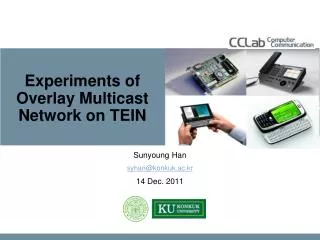
Ubiquitous Component Remoting Support on Overlay Network • Adaptation support with Ontology-based annotation • Roaming support of wireless component communication • Switching support of component communication using network processors • Streaming support of component communication for multimedia applications • Transcoding support (On-going)
Component Remoting Technology Map Component Remoting Technology Map
Switching support of component communication using network processors • Switching mechanism supports Remote Object Invocation, .Net Remoting and Java RMI. • The switching mechanism is implemented on IXP1200. • Porting the switching mechanism to IXP2400. • Future work: Parsing header, transcoding
Hardware comparison porting
Next Neighbor Register • Two mode of NNR: • Date can be read by next ME (ex. ME0:0 write data into a NNR, ME0:1 can read data from its NNR. ) • Use as extra GPR • NNR are useful when two pipeline stages are communicating. ME Cluster 0 ME 0:0 ME 0:1 ME 0:2 ME 0:3 ME Cluster 1 ME 1:0 ME 1:1 ME 1:2 ME 1:3
Metadata of packet Behavior of Packet Receiving 64Byte • Divide packet into mpackets • Store Mpackets into DRAM • Gather metadata from Mpacket 0 64 149 DRAM SOP EOP Metadata format dl_buf_handle //The current buffer containing SOP dl_eop_buf_handle // for large packets, the buffer containing EOP. input port // port from which the packet is rxed … … ScratchPad RAM
Ring Descriptors head tail 0 … 1 base 2 Size=128 15 Scratch Ring Scratchpad RAM SRAM Ring data Size = 128 …
Blueprint StrongARM Linux TCP/IP Stack Stack ACE • Ingress: one thread to receive packets from one 100 Mbps Ethernet port • Egress: a scheduler thread loads the packets from the packet queues of each port in round-robin fashion • L2 Bridge: relays and filters frames • L3 Forwarder: forwards packets based on a forwarding table • Stack ACE: allows I/O to and from the TCP/IP stacks and ACEs • Load Balancer: distributing requests to servers according to servers’ load Ingress ACE L2 Bridge Load Balancer L3 Forwarder Egress ACE Resource Manager ME 1 L2 LB L3 ME 2 ME 0 L2 LB L3 ME 5 Ingress Microcode Egress Microcode ME 3 L2 LB L3 ME 4 L2 LB L3
ME 0:1 ME 0:3 ME 0:2 De-capsulate De-capsulate De-capsulate Forward Forward Forward Load-balancer Load-balancer Load-balancer ME 1:3 ME 1:2 ME 0:0 ME 1:0 ME 1:1 Packet Tx Microcode Packet Rx Microcode Packet QM Microcode Packet Scheduler Microcode Packet Tx Microcode New Blueprint for IXP2400(Microengine) Communication with Core components Use Neighbor Register
Progress • What is done • Microcode • New blueprint of switching mechanism on IXP2400 • Todo • Core component • Performance measure