Understanding Subatomic Particles: Electrons, Protons, and Neutrons
This overview explores the fundamental subatomic particles in an atom: electrons, protons, and neutrons. Electrons are negatively charged particles with negligible mass, located outside the nucleus. Protons are positively charged, with a mass of approximately 1 atomic mass unit (amu), housed within the nucleus. Neutrons, which have no charge and the same mass as protons, are also found in the nucleus. The discovery of neutrons by James Chadwick is highlighted, showcasing their significance in atomic structure and chemistry.

Understanding Subatomic Particles: Electrons, Protons, and Neutrons
E N D
Presentation Transcript
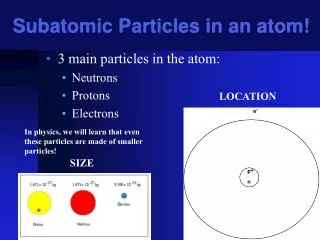
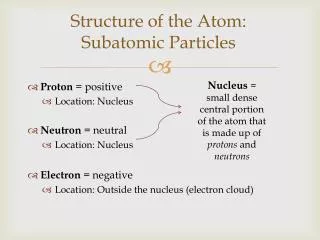
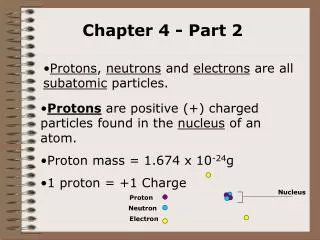
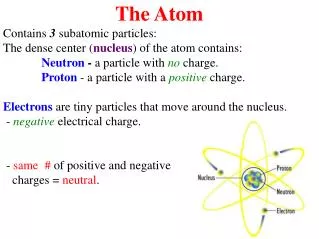
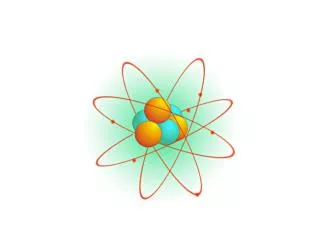
Particles in the Atom Electrons (-) charge no mass located outside the nucleus Protons (+) charge 1 amu located inside the nucleus Neutrons no charge 1 amu located inside the nucleus
+ Discovery of the Neutron + James Chadwick bombarded beryllium-9 with alpha particles, carbon-12 atoms were formed, and neutrons were emitted. *Walter Boethe Dorin, Demmin, Gabel, Chemistry The Study of Matter 3rd Edition, page 764
Subatomic particles Actual mass (g) Relative mass Name Symbol Charge Electron e- -1 1/1840 9.11 x 10⁻²⁸ Proton p+ +1 1 1.67 x 10⁻²⁴ Neutron no 0 1 1.67 x 10⁻²⁴
QUARKS equal in a neutral atom Atomic Number equals the # of... Most of the atom’s mass. Subatomic Particles ATOM NUCLEUS ELECTRONS NEUTRONS PROTONS Negative Charge Positive Charge Neutral Charge Courtesy Christy Johannesson www.nisd.net/communicationsarts/pages/chem