The Role of the Church in the High Middle Ages: Power, Influence, and Transformation
The High Middle Ages witnessed the Church as an omnipresent authority amidst stress and insecurity. It served various societal roles, from crowning monarchs to acting as a referee in conflicts. Though fragmented before 1000 AD, reforms by Gregory VII and Innocent III centralized papal power, establishing the Church as a significant political and spiritual force. The emergence of universities and intellectual movements like Scholasticism propelled modernization, even as the Church later faced challenges from the Crusades. This period illustrates a transition towards a more competitive, innovative Europe where church and state became distinct institutions.

The Role of the Church in the High Middle Ages: Power, Influence, and Transformation
E N D
Presentation Transcript
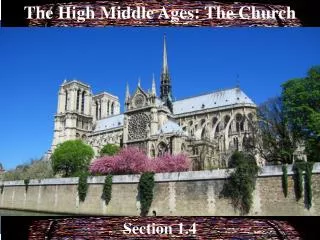
Section 1.4 The High Middle Ages: The Church
Church is Omnipresent • Act of Homage • Monarchial Crowning • Guilds had patron saint • Cathedrals • Referee at battles • Served as the KYW of its time • News, time, when to plant/harvest
How does this work by Sassetta capture the medieval Weltanschauung?Vat’s a Weltanschauung, anyvay (oops)? Anyway…
What was the Church like before 1000? • Fragmented and localized • Clergy uneducated, illiterate, semi-pagan • Corrupt clergy
How did Gregory VII extend Papal power? • Called for more discipline in Church • Celibacy • Declared that Pope is supreme over Kings • Called for end of lay investiture • Henry IV of HRE • excommunicated
How did Innocent III extend Church Power? • Forbade priests from officiating ordeals/battles • Relics controlled • Sacraments declared path to salvation • Transubstantiation declared legit
How did the Church’s intellectual activity grow and contribute to Europe’s modernization? • Universities formed after 1200 • Thomas Aquinas • Saved works of the Ancients • Scholasticism • Note: It also held back modernization later
The Crusades • Religious Wars • Pope Urban II (1095) • Reasons for calling them? • Jerusalem • Christian Unity (East and West) • Riffraff • Other?
What impact did the Crusades have on Europe? • Power of pope and of Europe • Ultimately weakened Church (Children’s Crusade) • Exposed Europeans to a more advanced culture • Opened up trade with the East
Europe (of 1300) is on the Threshold of the Modern Age • Competitive and innovative • Church and State are separate institutions • Urban centers growing • Parliamentary and judicial institutions promote codified law • Intellectuals willing to challenge old traditions