Understanding Similar Polygons and Triangles: Key Concepts and Theorems
This guide covers essential concepts and techniques for identifying and working with similar polygons and triangles. Learn how to recognize pairs of similar shapes, use proportions to calculate missing side lengths, and determine the measures of missing angles. Explore the Angle-Angle (AA) Postulate, the SSS (Side-Side-Side) Theorem, and the SAS (Side-Angle-Side) Theorem to establish similarity between triangles. Through practical examples, enhance your understanding of similarity and solve related problems confidently.

Understanding Similar Polygons and Triangles: Key Concepts and Theorems
E N D
Presentation Transcript
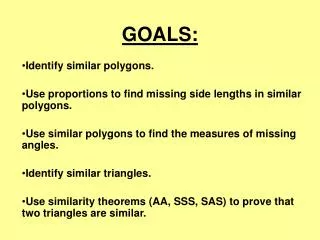
GOALS: Identify similar polygons. Use proportions to find missing side lengths in similar polygons. Use similar polygons to find the measures of missing angles. Identify similar triangles. Use similarity theorems (AA, SSS, SAS) to prove that two triangles are similar.
8.4 and 8.5 SIMILAR TRIANGLES • Angle-Angle (AA) Similarity Postulate: if two angles of one triangle are congruent to two angles of another triangle, then the triangles are similar
SSS Similarity Theorem: if the lengths of the corresponding sides of two triangles are proportional, then the triangles are similar
SAS Similarity Theorem: if an angle of one triangle is congruent to an angle of a second triangle and the lengths of the sides including these angles are proportional, then the triangles are similar
:30 Is ΔABC ~ ΔADE? • Yes, by AA. • Yes, by SSS. • Yes, by SAS. • No
:30 What is the scale factor of ΔUVW to ΔXYZ? • 7.5/12 • 12/7.5 • 5/6 • 6/5
:90 What is VW? • 6 • 9 • 10 • 14.5
:45 If mU = 50° and mY = 30°, what is mZ? • 30° • 50° • 100°