Muscular System
This article by Morgan Davis and Hannah Williams provides a comprehensive overview of the muscular system, detailing its three types of muscles: skeletal, smooth, and cardiac. It discusses their characteristics, including contractibility, excitability, extensibility, and elasticity. The text also highlights common disorders such as tetanus, shin splints, hernias, and strains, explaining their causes and effects. Aimed at those interested in human anatomy, this resource serves as an informative guide to understanding muscle function and related conditions.

Muscular System
E N D
Presentation Transcript
Muscular System By: Morgan Davis & Hannah Williams
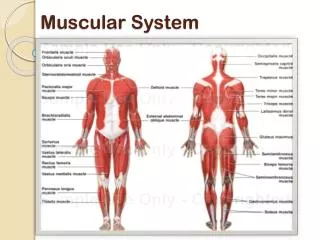
Anatomy • Three types of muscles; skeletal, smooth or visceral, and cardiac. • Skeletal-Muscle is attached to the bone. They are striated and voluntary. • Smooth-Muscle lines the internal part of the organs and they are not striated. They are involuntary muscles. • Cardiac-The muscle is only found in the heart. They are striated and involuntary.
Anatomy (continued) • Sphincter or dilator muscles are special muscles in the openings between the esophagus and the stomach.
Physiology • Contractibility is when a muscle shortens or contracts and reduces the distance between the parts of its contents or the spaces it surrounds. • Excitability is the ability to respond to certain stimuli.
Physiology (continued) • Extensibility is the ability to be stretched. • Elasticity is the ability to return to original length when relaxing.
Pathophysiology • One disorder of the muscular system is tetanus (lockjaw). This is an infectious disease characterized by continuous spasms of the voluntary muscles. Caused by the toxin bacillus. • Shin Splints- Injury to the muscle tendon in front of the shins. Occurs when jogging.
Pathophysiology (continued) • Hernia- Occurs when an organ protrudes through a weak muscle. There are three types of hernias, which include abdominal hernia, inguinal hernia, and hiatal hernia. • Strain-a tear in the muscle resulting from excessive use.
Corresponding Systems • Nervous System • Special Senses • Skeletal System
Citations • Orange Book • www.google.com/images