Investigating Low Energy X-rays from the Sun: Challenges and Innovations
210 likes | 319 Views
This article explores the structure of the Sun and the enigmatic nature of its corona, which exhibits unexpectedly high temperatures exceeding 1 million K yet emits no visible light. The work examines various theories of coronal heating, such as wave dissipation and nano-flares. It discusses advancements in X-ray imaging detectors, including their history and technological innovations that enhance the study of solar phenomena. Insights into space weather monitoring and the implications for communication systems and satellite operations are also addressed.


Investigating Low Energy X-rays from the Sun: Challenges and Innovations
E N D
Presentation Transcript
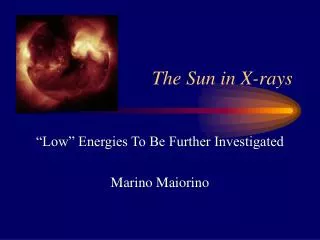
The Sun in X-rays “Low” Energies To Be Further Investigated Marino Maiorino
Summary • The Sun and Its Structure • Light as a Measurement Tool • The Corona Mistery • The Present Theories • Watch the Sun! • Going to Space • X-ray Imaging Detectors • New Technologies • Conclusions
The Sun and Its Structure • Core • p-p reaction • 1.5·107 °K • Radiative Zone • Convective Mantle • Outer, “atmosphere” layers: • Photosphere (5800 °K) • Chromosphere • Transition region • Corona
Light as a Measurement Tool • Black body spectrum and a bunch of laws: • Temperature as a Function of Depth • lmaxT = constant!
The Corona Mystery • What’s Corona? • Outer atmosphere of the Sun. • Thickness is a million km, but is possibly even larger. • The Corona is too hot to emit visible light. • How can we see it? • During a solar eclipse, observe light reflected from the dust particles associated with it. • Directly, using an X-ray telescope.
The Corona Mystery • Temperatures in Corona • Temperature > 106 °K: emission in X-rays!
The Corona Mystery • In literature you can find: • “The reason for the enormous temperatures in the corona is not well understood, but may relate to heating by the Sun's magnetic field lines…” • Theories: • Wave dissipation • Nano-flares • … • Also see: • http://arxiv.org/PS_cache/astro-ph/pdf/0203/0203167.pdf
The Present Theories • Wave Dissipation • Acoustic heating: ruled out due to dependency of Lx on rotational speed; • Magneto-acoustic heating: heating by waves and/or particles induced from magnetic fields at the bottom of the corona.
The Present Theories • Nano-Flares • Sun emits strong bursts of X-rays before the UV lightning of flares • A large number of very small “nano-flares” was proposed as a mechanism to heat Corona • Theory: at 250’000 °K some magnetic reconnection takes place between chromosphere and corona • SOHO saw low temp. gas (<400’000°K) going down; hotter gas going up • Nowadaysit is thought to be one of the mechanisms involved in coronal heating, NOT the most important one
Watch the Sun! • Usefulness of a Sun-staring mission to monitor “Space weather”: • Short radio waves propagation (e.g.: cellphones, radars and antennas) • Artificial satellite communications (research, GPS-navigation satellites) • Artificial satellite orbits (Earth atmosphere inflation) • Electric power grids (tranformers overload) • Health-damaging radiations (astronauts, jet passengers)
Going to Space • Our atmosphere, again...
X-ray Imaging Detectors • History of X-ray detection in space • Uhuru (US), 1970-73, 2-20 keV, proportional counters • OSO7 (US), 1971-74, 1 keV – 10 MeV, prop. counters + X-ray telescope • SAS3 (US), 1975-79, 0.1-60 keV, prop. counters collimated • HEAO1 (US), 1977-79, 0.2 keV – 10MeV, plenty of experiments • Einstein (US), 1978-81, 0.2-20 keV, grazing incidence telescope • Ginga (JAP), 1987-91, 1-500 keV, prop. counters • GRANAT (RUS-EU), 1989-98, 2 keV – 100 MeV, coded mask telescope • ROSAT (D-US-UK), 1990-99, 0.1-2.5 keV, X-ray telescope + high resolution imager • XMM-Newton (EU), 1999, 0.1-15 keV, grazing incidence X-ray imaging telescope • Chandra (US), 1999, 0.1-10 keV, grazing incidence telescope
X-ray Imaging Detectors • So “low” energies? • 2·106 °K / 11604 = 172 eV (a few nm) • In the “soft” X-ray band (0.12 - 5 keV) the Sun is the brightest X-ray source (by a factor of 106): X-ray Sun Luminosity = 1027 erg/s!
X-ray Imaging Detectors • Focusing Technologies: • X-ray (grazing) telescopes • Coded mask aperture telescopes • Detection Technologies: • Imaging Proportional Counters • Microchannel Plates • CCD Spectrometers • Imaging Gas Scintillation Proportional Counters
X-ray Imaging Detectors • Existing Projects • SOHO (NASA-ESA) • Yohkoh (JAP) • GOES-12 (NASA-NOAA) • TRACE (NASA) 171-1600 Å • RHESSI (NASA) 3 keV – 20 MeV
New Technologies • Single-photon counters (Medipix): • An X-ray photon generates two particle showers (h+ and e-) in a solid-state detector • By suitably biasing the detector, one shower is sent to an electronic device, able to see it as a pulse • The electronic device is divided in picture elements: any of these pixels is able to count the incoming pulses • Lower energy limit: a few keV
New Technologies • 3D detectors: • Electrodes are close • Low full depletion bias • Low collection distance • Thickness NOT related to collection distance • No charge spreading • Fast charge collection • Micron scale • USE Latest MEM techniques • Pixel device • Readout each p+ column
New Technologies • Josephson Junction Arrays: • Two superconductors, separated by an insulating layer, form a Josephson Junction. • Cooper pairs can flow from one side to the other • If a small voltage (a few millivolts) is applied, an alternating current of frequency in the microwave range results • Tecnology already used in SQUID detectors (sensitive to magnetic fields) • By coupling the junction material to a particle absorber, you can see particles (infrared photons!) hitting the detector by monitoring the voltage in the circuit
Conclusions • Sun, our nearest star, still hides secrets... even there where it’s more transparent...; • Study of Sun is straightforward (well... let’s get to space, first...); • Imaging technologies are ready for new challenges; • A Sun-staring mission offers unusual economical points of interest!