System Solutions
This lecture provides a comprehensive overview of linear systems in mechanical and industrial engineering. Key topics include the definition of linear systems, the significance of eigenvalues in determining system stability, and the derivation of response functions such as impulse and step responses. The course integrates practical applications using MATLAB for computations involving the exponential function of square matrices and eigenvalues. By the end, students will appreciate the fundamental principles that govern linear control systems and their real-world implications.

System Solutions
E N D
Presentation Transcript
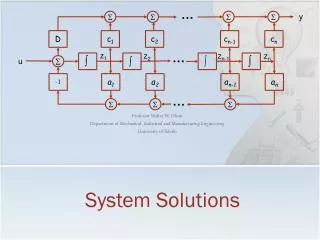
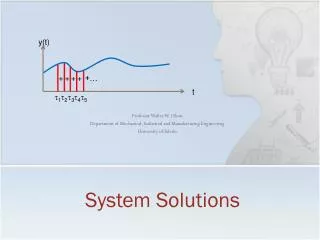
System Solutions Professor Walter W. Olson Department of Mechanical, Industrial and Manufacturing Engineering University of Toledo y(t) + + + + +… t t1 t2 t3 t4 t5
Outline of Today’s Lecture • Review • Linear Systems • Functions of Square Matrices • Eigenvalues • Stability • Modes • Convolution Equation • Impulse Response • Step Response • Frequency Response • Linearization
What is a Linear Systems • In order to be Linear, a system f(x) must obey the rules • So why is this important for controls?
Linear Control Systems • If we have two responses known from our system, say, then we also can find the response to the sum of the imput:
The Exponential Function of a Square Matrix A • A Taylor series of the exponential function of x is • Thus we can define as the matrix exponential • In Matlab, the comandexpm(A) computes • And we can use this just as we would any other function • For Example, the solution of is and
What is a measure of stability? • If you have been paying attention you noted that if the system terms were such thatthe system was stable! • So, can we evaluate in out state space model? If the system is Linear, we can.
Eigenvalues • As we are about to find out, the eigenvalues are the key to determining stability • For a square matrix with n rows, the determinant will form an n degree polynomial of the form • Eigenvalues are the roots of this polynominal, that is • Eigenvectors x are the solution to the equation • Many methods exist to find the values of eigenvalues and eigenvetors • In Matlab, the function eig(A) computes the eigenvalues
u Modes x k • Mode: A pattern of motion, sometimes called a mode shape u m x k Mode 1 m Fixed Refe: y Fixed Refe: y Mixed Mode u u Mode 2 x x k k m m m m Fixed Refe: y Fixed Refe: y
Modes • Each eigenvalue is associated with a mode of a system • Each eigenvalue is associated with an eigenvector, , such that • If the eigenvalues are distinct, we can form the modal matrix, M, from the eigenvectors and use it to diagonalize the dynamics matrix A which will then separate each mode in the form of a differential equation: • When a set of eignevectors are repeated (equal to each other) a full set of n linear independent eignevectors may or may not exist. In that case we need to form the Jordan blocks for the repeated elements
Modes • Jordan blocks have the form • The number of rows and columns of the Jordan block is the number of times (the multiplicity) that the eigenvector is repeated • Then the modes are separated by using the modal matrix as before, but now producing the Jordan form where each block now conforms to a mode.
Modes • Modes can be easily found using Matlab function Jordan: • The over decoupling of the system can be represented as >> A A = 1 -3 -2 -1 1 -1 2 4 5 >> [V,D]=eig(A) V = -0.4082 + 0.0000i -0.4082 - 0.0000i -0.7071 -0.4082 - 0.0000i -0.4082 + 0.0000i 0.0000 0.8165 0.8165 0.7071 D = 2.0000 + 0.0000i 0 0 0 2.0000 - 0.0000i 0 0 0 3.0000 >> J=jordan(A) J = 2 1 0 0 2 0 0 0 3
Transformations • We can transform our state space representation to other state variables (different that the ones in use). • Mathematically, this is called a change of basis vectors. • Why would we ant to do this? • To make the problem easier to solve! • To isolate a particular property of the system • To uncouple the modes of the system
Transformations • Say we have some matrix T that is invertible (this is important) which results in the vector z when x is premultiplied by T. We then say that we have transformed the vector x into z, or alternatively, we have transformed x into z:
Convolution Equation is called the “Convolution Equation” Expresses the effect of an input on the system • What is convolution? • a twisting or folding together of two things • A convolution is found in many phenomena: • A sound that bounces off of a wall and interacts with the source sound is a convolution • A shadow is a convolution between the light source and the object producing the shadow • In statistics, a moving average is a convolution
Convolultion • Example
Transformations of our solution • A property of matrix exponentials is that • Therefore
The Impulse Function • Imagine a function that has a shape that is infinitesimally thin in the independent variable but infinitely high domain or response: • In other words this is a very long and sharp spike • This is what we try to model with the impulse function • Mathematically we define the Dirac Delta Function, d(t), also called the Impulse Function by
Properties of the Impulse Function f(t) f(a) t a “Time shift property”
System Response Since our system is linear and we can add solutions, we can approximate the response as a sum of the convolutions of h(t-t)d(t) y(t) + + + + +… t t1 t2 t3 t4 t5
System Response S(t) • A unit step is defined as • With zero initial conditions 1 { Overshoot Mp t Steady State Rise time, tr Transient period=settling time, ts } } Transient Steady State
System Response • Another common test function is a sinusoid for frequency response • Since we have a linear system, we only need and assuming that the eigenvalues A do not equal s } } Steady State Transient
System Response: Frequency Response • Time history with respect to a sinusoid: Phase Shift, DT Amplitude Ay Amplitude Au Input Sin(t) Period,T Transient Response
System ResponseFrequency Response M is the magnitude and q is the phase
Linearization • Good solutions for the Linear Model • Equally good techniques for the Nonlinear Model are not easy to come by • What if the Nonlinear Model is well enough behaved in the region of interest so that we could apply Linear techniques strictly to that region? • We did this with the inverted pendulum! • We assumed small angles!
Linearization Techniques • Ignore the nonlinearity • In some cases, the nonlinearity has a relatively small effect • In those cases, build a linear system and treat the nonlinearity as a disturbance • Small angle approximations • Often only useful near equilibrium points • Taylor Series Truncation about an operating point • Assumes that 2nd and higher orders are negligible • Feedback linearization 0
Summary S(t) • Convolution Equation • Impulse Response • Step Response • Frequency Response • Linearization 1 t Next: Reachiblity