Interactive Web Development Course: Scripting Events and Language Elements
Learn to create multiplayer apps on the web using scripting events, event triggers, implicit parameters, and flow control constructs. Dive into array and set manipulation for dynamic content.

Interactive Web Development Course: Scripting Events and Language Elements
E N D
Presentation Transcript
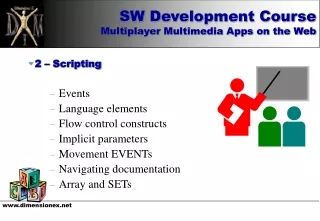
SW Development CourseMultiplayer Multimedia Apps on the Web 2 – Scripting Events Language elements Flow control constructs Implicit parameters Movement EVENTs Navigating documentation Array and SETs
EVENT • Whatever happens, an EVENTO triggers • When an EVENT triggers, the system looks for a specific piece of software • At each call, if that piece of software is found, it is executed
EVENT example • At the game’s startup • onStart Event • If code for onStart is found, it is executed
EVENT • EVENT id_evento • Instruction • Instruction .. • End_EVENT verify Developers Ref.
EVENT Example • EVENT onStart • Call PopMonster() ‘My function – make a monster ‘to pop up in a random room • End_EVENT
EVENT example • A character gets looked at (clicked on) • The event person.onLook triggers • If existing, the event gets executed and stop. • Otherwise the generic event onLook triggers • If existing, the event gets executed.
Implicit parameters • $OWNER – who owns the event equals to this in Java • $AGENT – who started the action • $TARGET – third actor (sometimes used, mostly not)
EVENT Model: person.onLook $AGENT $OWNER
onLook EVENT Example SCRIPTS EVENT guy.onLook Speak $OWNER,$AGENT,“So, what’s up?" END_SCRIPTS
Speak • Speak [speaker,][destination,] phrase [, phrase …] • “speaker” Defaults to: $OWNER • “destination” Defaults to: $AGENT • If there are many phrases, they are printed in cycle
Speak from this… SCRIPTS EVENT guy.onLook Speak $OWNER,$AGENT,“So, what’s up?“ END_SCRIPTS
…to this (compact form) SCRIPTS EVENT guy.onLook Speak“So, what’s up?“ END_SCRIPTS
Pre-defined values SYS (System voice) • Use as “speaker” when needed $WORLD (All connected players) • Use as “destination”
onLook EVENT Example SCRIPTS EVENT guy.onLook Speak SYS,$WORLD,“Player “ + $AGENT + “ looks “ + $OWNER END_SCRIPTS
Object Model di CHARACTERS • Use the dot . to refer to an object’s property Person.name Name of the person Person.container Where person is (room object) Person.container.id (room’s ID) Person.container.name (room’s name)
Print • Print [dest,] What [, what…] • Print “In this room there’s some light” • Print “OWNER=“ + $OWNER + “ AGENT= “ + $AGENT + “ TARGET=“ + $TARGET
Assignment – remember a value • Birthday = “July 26th” • Print Birthday July 26th
If .. Else • If (condition) • Istructions • Else • Istructions • End_If • No THEN • End_If and not: “End If”
RndInt(N) • Returns a random nunmber from 1 a N
If .. Else IfRndInt(2) = 1 Print “ODD!” Else Print “EVEN!” End_If
EVENT Model: person.onHear $TARGET $AGENT $OWNER
Printing implicit parameters • Print “OWNER=“ + $OWNER + “ AGENT= “ + $AGENT + “ TARGET=“ + $TARGET
Inspecting the log • System folder • File name is: debug#.log • # = number of slot you used • Note: If it is missing then edit setting debugTo= in the worldnav#.properties file
Echoing speech • EVENT person.onHear • Speak $OWNER,$AGENT,”You said: “ + $TARGET + “, what do you mean?” • END_EVENT
EVENT Model: room.onLoose $AGENT $TARGET $OWNER
EVENT Model: person.onExit $OWNER $AGENT $TARGET
EVENT Model: person.onEnter $OWNER $AGENT $TARGET
EVENT Model: room.onReceive $AGENT (?) $TARGET $OWNER
Navigating Developers Reference • How DimensioneX works • Configuration • Design-time part (DXW) • Run-Time part (SmallBasic) • Objects’ Object Model • System (built-in) Events • Available Functions • Available Istructions
Array arrGreets 1 2 3 4 “ciao” “hola” “hi” “hello”
Array + RndInt(N) • arrGreets = NewSet(“ciao,hola,hello”) • Speak arrGreets(RndInt(3)) • Ciao • Hello • Ciao • Hola
SET setObjects book crown scroll sword
For Each Next • For Each var In set • Instructions • Next • Careful! To set and arrays
For Each Next + SET Print “present characters:” For Eachx In getCharactersIn($WORLD) Printx.name Next
Summary • Events • Language elements • Flow control constructs • Implicit parameters • Movement EVENTs • Navigating documentation • Array and SETs