Download
1 / 19
190 likes | 316 Views
This workshop presentation discusses the intricate behavior of quarkonium states within the quark-gluon plasma (QGP). It covers the impact of color screening on binding energies, the formation and dissociation reactions of quarkonium pairs, and the adjustable heavy-quark mass effects in the medium. Utilizing effective potential models and lattice QCD results, the work highlights the challenges in connecting experimental yields and spectral shapes with theoretical predictions. The dynamics of charm and bottomonia in high-energy collisions are explored, emphasizing the importance of understanding the QGP in nuclear physics. ###

E N D
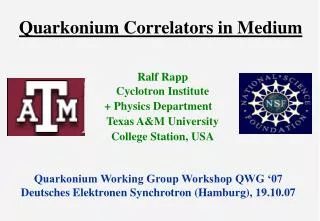
Quarkonium Correlators in Medium Ralf Rapp Cyclotron Institute + Physics Department Texas A&M University College Station, USA Quarkonium Working Group Workshop QWG ‘07 Deutsches Elektronen Synchrotron (Hamburg), 19.10.07
_ Q-Q Potential Scattering Rates Q Selfenergy 1.) Introduction:Quarkonia Probing the QGP • immerse -pair into the QGP • Vacuum properties change: • color screening (reduced binding) • dissociation reactions (and reverse!) • heavy-quark mass (→ mass, decay rates, threshold) • Experiment: Heavy-Ion Collisions • yields; no access to spectral shape (?) • mass ↔ equilibrium number ~ exp(-M/T) • pT-spectra, v2(pT) Theory:- in-medium -spectral functions - Euclidean correlators: lattice QCD ↔ effective models
Outline 1.) Introduction 2.) Potential Models + Spectral Functions 2.1 SFs + Correlators, Lattice Results 2.2 Potential Models (Schrödinger/T-Matrix) 2.3 Uncertainties in Potential + HQ Mass 3.) T-Matrix Approach 3.1 Baseline Results 3.2In-Medium HQ Masses 3.3Width Effects 4.) Charmonia at RHIC 5.)Summary + Outlook
2.1 Euclidean Correlator + Timelike Spectral Function Early Example: Dileptons (r, w) integrate [Wetzorke et al ‘01] [RR ‘01] • schematic at the time
2.1.2 Lattice QCD Computations: G / Grecon+ SFs • accurate “data” from lattice QCD hc cc [Datta et al ‘04] • S-wave charmonia little changed to ~2Tc, P-wave signal enhanced(!) • similar in other lQCD studies [Iida et al ’06, Jakovac et al ’07, Aarts et al ’07]
- Q-QT-Matrix: 2.2 Potential-Model Approaches for Spectral Fcts. s/w2 • Schrödinger Eq. for bound • state + free continuum • sy(w) = Fy2d(w - my )+w2Q(w-Ethr) fythr • - improved for rescattering J/y [Shuryak et al ’04, Wong ’05, Alberico et al ’05, Mocsy+Petreczky ’05] Y’ cont. w [Mocsy et al ’06, Laine ’07, Wong et al ’07, Alberico et al ‘07] Ethr • Lippmann-Schwinger-Eq. • for [Mannarelli+RR ’05,Cabrera+RR ‘06] - 2-quasi-particle propagator: - bound+scatt. states, nonperturbative threshold effects (large!) • Correlator: L=S,P
2.3.1 Uncertainties I: “Lattice QCD-based” Potentials • free vs. internal energy: F1 (r;T) = U1(r;T) – T S(r;T) • (much) smaller binding for • V1=F1, V1 = (1-a) U1 + a F1 [Cabrera+RR ’06; Petreczky+Petrov’04] [Wong ’05; Kaczmarek et al ‘03]
2.3.2 Uncertainties II: Heavy-Quark Masses in the QGP • quarkonium mass:my= 2mc* - eB • asymptotic energiesF∞ = U∞ - TS∞ U∞ [Kaczmarek +Zantow ‘05] F∞ • close toTc: - increasing heavy-quark mass?! • - entropy contribution?
3.) T-Matrix Approach 3.1 Baseline Results 3.2In-Medium HQ Masses 3.3 Width Effects [Cabrera+RR ‘06]
3.1 Baseline Results:V1=U1, mc=1.7GeV fix, Gy small, Grec= Gvac - Q-QT-Matrix • ~40% variation in S-wave (1.1Tc overbound), P-wave: zero modes needed hc cc • slightly overbound at 1.1Tc • (or mc too small) • dissolves at >2.5Tc • quickly dissolves above Tc
3.2 T-Matrix with in-medium mc* - I • lattice U1-potential, mc* from U1subtraction hc • upward shift due to large mc* at 1.1Tc • ~stable my=2mc*-eBabove → correlator within ~20%
3.2.2 T-Matrix with in-medium mc* - II • lattice U1-potential, adjust mc* close to Tc + zero modes;S-Waves: [Cabrera+RR in prep] T-Matrix Approach [Aarts et al. ‘07] Lattice QCD J/y hc • fair agreement!
3.2.3 T-Matrix with in-medium mc* - II • lattice U1-potential, adjust mc* close to Tc + zero modes; P-Waves: [Cabrera +RR in prep] T-Matrix Approach [Aarts et al. ‘07] Lattice QCD cc0 cc1 • fair agreement!
3.2.4 Temperature Dependence of Charm-Quark Mass • significant deviation only close to Tc
_ • effect on correlator • moderate width • → small enhancement hc [Cabrera+RR ‘06] 3.3 Finite-Width Effects • c-quark width in propagator • dominant process depends on eB J/y Lifetime [Grandchamp+RR ‘01]
4.) Observables at RHIC: Centrality + pT Spectra • updated predictions including 3-momentum dependencies [X.Zhao+ RR in prep] • balance direct - regenerated • sensitive to: mc* , Ncc
5.) Summary • potential models useful tool to interpret finite-T lQCD • importance of nonperturbative threshold effects • consistency of bound+scatt. states + mc* mandatory (T-matrix) • significant uncertainties (U1 vs. F1 , mc*) • S-wave charmonia survival to2-3Tcin line with lQCD correlators • no conclusive interpretation yet: • threshold reduction compensates decreasing binding • quarkonium lifetimes of tY ≤ 1fm/c possibly relevant
- → ← J/y + g c + c + X key ingredients: reaction rate equilibrium limit (y -width) (links to lattice QCD) 4.) Suppression + Regeneration in Heavy-Ion Collisions • 3-Stage Dissociation:nuclear (pre-eq) -- QGP -- HG • Stot = exp[-snucrL] exp[-GQGPtQGP ] exp[-GHGtHG ] • Regeneration in QGP + HG: • - microscopically: backward reaction (detailed balance!) - snuc(SPS) ≈ 4.5mb - RHIC d-Au data → snuc≈ 0-3mb [PBM etal ’01, Gorenstein etal ’02,Thews etal ’01, Grandchamp+RR ’01, Ko etal ’02, Cassing etal ‘03] - for thermal c-quarks and gluons:
3.3.2 Observables II: Excitation Function + Rapidity J/ySuppression vs. Regeneration SequentialY’+cc Suppression [Grandchamp +RR ’01] [Karsch,Kharzeev+Satz ‘06] • direct J/yessentially survive • (even at RHIC) • nontrivial “flat” dependence • similar interplay in rapidity!? • (need accurate dNc/dy)