Download
1 / 19
190 likes | 312 Views
This comprehensive guide by Dr. Javier Torner focuses on establishing a Public Key Infrastructure (PKI) system vital for securing communications against eavesdropping, tampering, and impersonation. It covers essential topics such as basic cryptography, including symmetric and asymmetric encryption, and the roles of keys and certificates. Learn about the components and services necessary for successful PKI deployment, authority validation, and identity management. With applications like SSL certificates and digital signatures, readers will gain insights on effectively implementing their own PKI solutions.

E N D
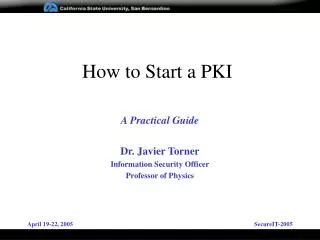
How to Start a PKI A Practical Guide Dr. Javier Torner Information Security Officer Professor of Physics
Agenda • Why do you need a PKI? • Basic Cryptography • “Near Future” PKI Applications • PKI Components and Services • Deployment of a PKI
Why do you need a PKI? • Protects against eavesdropping • Protects against tampering • Prevents impersonation • Spoofing • Misrepresentation • Provides stronger authentication
Basic Cryptography • Use of Keys for Encryption and Decryption • Types of Keys • Symmetric-Key Encryption • Uses ONE single key (shared secret) • Efficient • Provides a minor degree of authentication • Only effective if symmetric key is kept secret!! • Public-Key Encryption (asymmetric encryption) • Involves a pair of keys: • Public Key – Published • Private Key – Kept secret • Key Length and Encryption Strength • Strength of encryption is related to the difficulty of discovering the key • Encryption strength is described in terms of key size.
Public Key Cryptography Provides: • Encryption and Decryption • Strong authentication • Non-repudiation • Tamper detection
What is a Certificate? • A certificate is an electronic document used to identify: • An individual • A server • A company • Other entities • A certificate associates an identity with a public key
What is a Certificate Authority? • A Certificate Authority (CA) • validates identities • issues certificates • Validation/Assurance of identity • depend on the policies of a given CA
Contents of a Certificate • A certificate (X.509 v3) binds a Distinguished Name (DN) to a public key. • A DN is a series of “values” that uniquely identify an identity. For example: cn=Javier Torner, email=jtorner@csusb.edu, o=California State University San Bernardino, ou=Information Security Office
Near Future Application • Digital Signatures (S/MIME) • Mail Encryption • Certificate Revocation • SSL Client Certificates to POP/IMAP • SSL Client Certificates to NNTP • SSL Client Certificates for network access • Hardware Tokens – Two factor authentication
PKI Components and Services • Certificate Repository • Certificate Revocation • Key backup and recovery • Support for non-repudiation • Time stamping • Client software
PKI Phases • Phase 0 – Basic Infrastructure • Implement a Certificate Authority • Hierarchy Structure • Phase I – Authorization • Phase II – Authentication • Phase III – Incorporate a Trusted Bridge
PKI - Phase 0 • Define Certificate Practice Statement • Define a CA Hierarchy • Root CA • Master or Secondary CA • SSL (Web server) CA • SSL Clients CA • E-mail/Encryption CA • Object CA
CA Certificate Practice Statement • Easy way to start is using PKI-Lite • Edit/modify to your institution • Technology has been around, but relatively new
PKI - Phase I • Select software • OpenSSL, OpenCA • Issue SSL Server Certificates • Class 3 Web servers certificate • Develop/enable users request interface • Provide user education • SSL Client Certificates • Start with certificates for authentication “ONLY” • Test on control systems • ISO sites
SSL Client Certificates • Provides the ability to authenticate (primarily web) users using your institution’s certificate • Allows you to easily restrict the users of your data based upon criteria within a certificate
Contents of a Phase IServer Certificate • CN=www.infosec.csusb.edu • Email= • OU=Information Security Office • O=California State University San Bernardino • L=San Bernardino • ST=California • C=US
Contents of a Phase-IID Certificate • CN=Javier Torner • Email=jtorner@csusb.edu • OU=Information Security Office • O=California State University San Bernardino • L=San Bernardino • ST=California • C=US
The Future of PKI • Phase 3 – Federated • Application Design • CA Development
Valuable Resources • http://www.modssl.org • http://www.openssl.org • http://www.openca.org • http://www.educause.edu/HEPKI • Understanding PKI – Carlisle Adams and Steve Lloyd (ISBN 1-57870-166-x) • Digital Certificates – Jalal Feghhi, Jalil Feghhi, Peter Williams (ISBN 0-201-30980-7)b