Download
1 / 31
Understanding Cache Block Addresses for Data Placement in Memory
310 likes | 438 Views
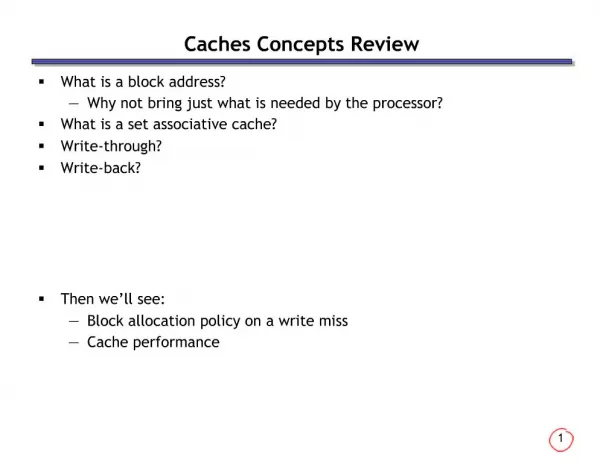
This review explores how to determine where data should be placed in a cache using block addresses. By conceptually splitting main memory into chunks that match the cache block size (2^n bytes), we can identify the corresponding block for any byte address. For a given byte address i, the block address can be calculated through integer division (i / 2^n). This fundamental concept is pivotal for efficient cache utilization and memory management in computer architecture.

Download Presentation 
Understanding Cache Block Addresses for Data Placement in Memory
An Image/Link below is provided (as is) to download presentation
Download Policy: Content on the Website is provided to you AS IS for your information and personal use and may not be sold / licensed / shared on other websites without getting consent from its author.
Content is provided to you AS IS for your information and personal use only.
Download presentation by click this link.
While downloading, if for some reason you are not able to download a presentation, the publisher may have deleted the file from their server.
During download, if you can't get a presentation, the file might be deleted by the publisher.
E N D
Presentation Transcript









More Related