Understanding Thermochemistry: Heat Measurement, Energy Types, and Phase Changes
This resource provides a comprehensive overview of thermochemistry, focusing on the definitions and measurements of heat in chemical processes. It discusses the SI unit of heat (Joule) and compares it with the calorie. Key concepts include energy types (potential, kinetic, thermal), energy changes during reactions (enthalpy), and the principles of calorimetry for measuring heat absorption or release. The document also explains exothermic and endothermic processes, along with phase changes in substances as influenced by temperature and pressure, illustrated through phase diagrams.

Understanding Thermochemistry: Heat Measurement, Energy Types, and Phase Changes
E N D
Presentation Transcript
Basic Thermochemistry Courtesy of lab-initio.com
Units for Measuring Heat The Joule is the SI system unit for measuring heat: The calorie is the heat required to raise the temperature of 1 gram of water by 1 Celsius degree
Energy Heat (Enthalpy) Change, ΔH • Energy is the capacity to do work, and can take many forms • Potential energy is stored energy or the energy of position • Kinetic energy is the energy of motion • Thermal energy (heat) is an outward manifestation of movement at the atomic level Definition:The amount of heat energy released or absorbed during a process.
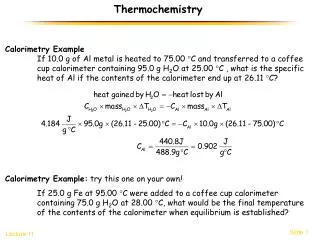
Calorimetry The amount of heat absorbed or released during a physical or chemical change can be measured, usually by the change in temperature of a known quantity of water in a calorimeter.
Processes in which energy is released as it proceeds, and surroundings become warmer Exothermic Processes Reactants Products + energy
Processes in which energy is absorbed as it proceeds, and surroundings become colder Endothermic Processes Reactants + energy Products
Water phase changes constant Temperature remains __________ during a phase change.
Processes occur by addition of energy Phase Change Diagram Processes occur by removal of energy
Phase Diagram • Represents phases as a function of temperature and pressure. • Critical temperature: temperature above which the vapor can not be liquefied. • Critical pressure: pressure required to liquefy AT the critical temperature. • Critical point: critical temperature and pressure (for water, Tc = 374°C and 218 atm).