Exploring Literary Devices in Sonnets: Connotation, Denotation, and More
This guide delves into the fundamental literary devices used in sonnets, focusing on key concepts like connotation, denotation, meter, and poetic devices. It explains the emotional nuances of word choices through connotation and denotation, distinguishing between the explicit and the implied meanings. Furthermore, it highlights essential techniques such as meter, onomatopoeia, oxymoron, and the structure of Shakespearean and Petrarchan sonnets. Ideal for students and poetry enthusiasts, this resource provides insights into crafting and analyzing poems effectively.

Exploring Literary Devices in Sonnets: Connotation, Denotation, and More
E N D
Presentation Transcript
Literary Devices: 1/3 • Connotation: associated or secondary meaning of a word or expression in addition to its explicit or primary meaning. • --emotional attachment • Denotation: Dictionary definition of a word
Connotation/Denotation • Which word has a more positive connotation? Ted’s Restaurant is furnished with (old, antique) furniture. Mike’s (shabby, vintage) bike is black and gold. A group of (loud, enthusiastic) students walk to school every day. My parents argue (loudly, passionately) about politics over dinner.
Literary Devices • Meter: The recurring pattern of stressed and unstressed syllables. • Onomatopoeia: a word that imitates the source of the sound it describes. • Buzz • Oxymoron: a figure of speech that combines contradictory ideas. • Parallelism: a poetic device in which two or more words, phrases or lines of a poem reflect each others' content.
Literary Devices: • Pathos: The appeal to an emotion • Pun: A play on words, usually for comic reception. • Soliloquy: A dramatic monologue that represents a series of unspoken reflections.
Poetic Devices • Iamb: a group of two syllables with a unstressed and stressed syllable. • Iambic Pentameter: a line of 5 feet that are unstressed and stressed: • “That time of year thou mayst in me behold. • Feet: groups of syllables in a line. • Penta=5 • Meter=The basic rhythmic structure of a verse of lines in verse.
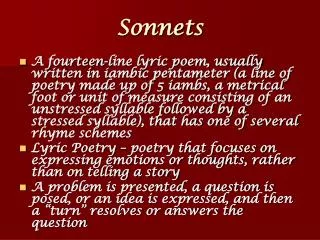
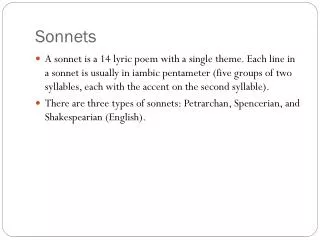
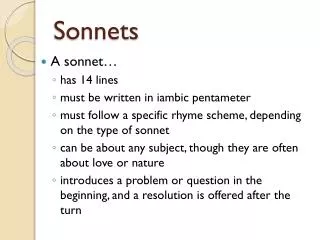
Sonnets • 14 lined poem • 2 types • Shakespearean • Petrarchan
Shakespearean Sonnet • 14 lines • 3 quatrains • 1 couplet that rhymes. • Generally written in Iambic Pentameter.