Download
1 / 37
370 likes | 501 Views
dAu at PHENIX: Insights on the Cronin effect, shadowing and saturation. Barbara Jacak For the PHENIX Collaboration pA Workshop, MIT May 18, 2013. BVJ history with Wit. Began reading his papers in 1980’s To guide first comparisons pp pA AA in HELIOS Met Wit at conferences

E N D
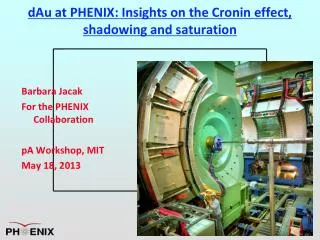
dAu at PHENIX: Insights on the Cronin effect, shadowing and saturation Barbara Jacak For the PHENIX Collaboration pA Workshop, MIT May 18, 2013
BVJ history with Wit • Began reading his papers in 1980’s • To guide first comparisons pp pAAA in HELIOS • Met Wit at conferences • Many discussions • some even in Polish… • Hung out together • QM2002, 2005, etc. • 2002 KITP program on • “QCD in the RHIC era” • Workshop in Santa Fe • In 1993 I always learned a lot!
The big question in p+A physics • Then (the pre-RHIC era): • What do subsequent p-nucleon collisions in p+A have to do with one another? • Now (the RHIC and LHC era): • What do gluons at small x inside a nucleus have to do with one another?
To answer this: PHENIX studies • Heavy flavor production: • g+gc + cbar • Jet and di-jet production: • g+gdi-jet • Direct photon production: • (QCD Compton process) • q+gg + hadrons
Heavy Flavor • Production of c+cbar and b+bbar • Nuclear gluon distribution in d+Au • initial state effects: • saturation • shadowing, anti-shadowing • parton energy loss • parton (re)scattering • quarkonia, open heavy flavor • Quarkonia survival probability • Sensitive to surrounding • medium in d+Au • J/ψ vs. ψ’ vs. Υ
Initial State:what’s where? Au Forward + y d-going Backward - y Au-going 8/13/12 d Au
J/ψ in d+Au PRL107, 142301 (2011) forward rapidity probes low-x in Au saturation predicts suppression forward data: non-linear suppression vs. density weighted longitudinal thickness • EPS09 nPDF’s: linear • break-up w/fixed sbr: exponential • data: ~quadratic increased suppression at forward rapidity also expected from initial state parton energy loss… Centrality dependence Suppression level
Dense gluonic matter effects observed PRL107, 142301 (2011) PRL107, 172301 (2011) Di-hadron suppression at low x pocket formula (for 22): Shadowing/absorption stronger than linear w/nuclear thickness As expected for CGC …
Shadowing, breakup & Cronin effect PRC87, 034911 (2013) • pT broadens (multiple scattering) w/Ncoll; effect stronger at y=0 • J/ψ suppression to higher pT @ mid & forward y (lower x in Au); • RdA>1 at high pT backward (Cronin effect in Au nucleus ) • pT, y, centrality dependence not reproduced by models
but Parton pT broadening and energy loss calculation (Arleo, et al 1304.0901) consistent with the data! shadowing+eloss or saturation?
Smaller, more tightly bound probe PRC87, 044909 (2013) • Hard to quantify comparison Υ in line with data at lower √s • Consistent with EPS09 shadowing + some nuclear breakup (recall: backward rapidity = Au-going)
Larger, less tightly bound ψ’ • Clearly more suppressed than J/ψ • Not shadowing or parton energy loss • These are initial state effects • World data on ψ’/ J/ψ: Decreases linearly withdNch/dh (independent of √s) • Supports: effect is not due toc-cbar production suppression break-up of some kind: early or late?
√s dependence is a key tool! • Time in nucleus is short at √s = 200 GeV • Shorter than bound state formation time! Late final state effect? • Suppression vs. dNch/dh suggests breakup by comoving hadrons? • dNch/dh=15 in central d+Au; ψ’ easier to break up than J/ψ (R. Vogt)
Rapidity dependence is coming Forward vertex detector FVTX improves mass resolution Ψ’ at forwardrapidity!
Open Heavy Flavor production in d+Au • Leave aside the question of final state breakup • Harder to measure the production cross sections • PHENIX approach is to use semi-leptonic decays • Measure non-photonic single leptons • Or intermediate mass lepton pairs • PHENIX provides reach in rapidity and Ncoll
Open heavy flavor rapidity dependence • Clear enhancement in Au-going direction sensitive to high-x in Au (Anti-shadowing regime) • Suppression in d-going direction sensitive to low-x (shadowing) • Enhancement also at mid-rapidity
At mid-rapidity PRL109, 242301 (2012) • RdA=1 for peripheral collisions • Enhancement at low pT in central collisions • Recall J/ψ pT evidence for parton multiple scattering • “classic” reason for Cronin Effect
NB: Classic does not always mean right! 👿 “old” problem with “Cronin effect = parton multiple scattering” • How does the parton know it will produce a proton?
<RAA> vs. Ncoll • Enhancement in cold nuclear matter • Then suppression in hot medium in A+A
Should take both into account! PRC84, 044905 (2011) 👿CNM baseline differs for p0 & e±
Another handle: di-electrons p+p PLB 670, 313 (2009) scharm in p+p: 544mb ±39(stat) ±142(syst) ± 200 (model) sbot: 3.9mb ±2.5(stat) +3-2(syst)
Good statisticsin d+Au 2008 run differential distributions in mass andpT!
Separate charm and bottom Charm dominates b dominates
NEED y, pT, centrality, √s, species to sort it out! Shadowing, etc. in CNM Suppression Cold matter “effective absorption” √s √s √s Final state recombination Screening in QGP Suppression Suppression
Turn now to jets and direct photons arXiv 1205.5359 Hellenius, Eskola, et al Fit data, including PHENIX p0RdAu Get b-dependent nPDFs
Suprising behavior of jets in d+Au Central Peripheral • Enhancement in peripheral, slight suppression in central Surprisingly strong centrality dependence in nuclear PDFs • Competing cold nuclear matter effects? Auto-correlations between high pT processes & centrality measure?
Do the p0 and jets agree? • Scale p0 by 1/0.7 • i.e. 1/<Zleading> • Agreement is excellent • Rcp shows strong centrality dependence Autocorrelation? How does the presence of a jet with pT>10 GeV/c modify definition of a “peripheral d+Au collision”?
gdirectin d+Au • No modification of direct photons in initial hard scattering and PDF compared to p+p at mid-rapidity
Initial State: shadowed or CGC? Dilute parton system (deuteron) PT is balanced by many gluons Dense gluon field (Au) Use direct photons!
MPC-EX upgrade 3.1 < h < 3.8 Reconstruct prompt g and p0 to 80 GeV: low & high x!
Will measure p+A in 2015 MPC-EX preshower: g vs. p0 decay Substantially improve nPDFs! • to x ~ 10-3 and also at high x 2-4 weeks running per species
Conclusions • Evidence for (expected) shadowing & antishadowing • Suppression of J/ψ and di-h beyond shadowing at low x!! • Heavy Flavor indicates • parton multiple scattering (Cronin effect) • parton energy loss; interplay w/other initial state effects? • final state effects break up quarkonia, too • Cronin effect: modifies charm suppression in A+A! • Jet trend with centrality remains mysterious • Need that “centrality” workshop – for RHIC+LHC! • No strong evidence for direct photon modification at mid-y • At least, not with current statistics • Need forward rapidity to probe low-x and pin down nPDFs NEED data vs. y, pT, centrality, √s, species to sort it all out! to Wit: still lots of fun to be had with p/d+Au!