Download
1 / 54
540 likes | 656 Views
Text clustering is an essential technique for unsupervised classification that groups similar data items into clusters, facilitating faster retrieval, improved browsing, and better data organization. This approach can utilize divisive or agglomerative methods and involves calculating similarities based on distance measures like cosine similarity. Challenges include determining the number of clusters and managing overlapping data. Evaluating cluster quality can involve internal measures like intra-cluster similarity and external knowledge such as entropy, assisting in assessing the effectiveness of clustering algorithms.

E N D
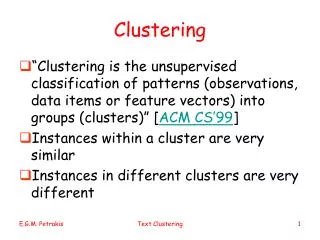
Clustering • “Clustering is the unsupervised classification of patterns (observations, data items or feature vectors) into groups (clusters)” [ACM CS’99] • Instances within a cluster are very similar • Instances in different clusters are very different Text Clustering
. . . t e r m 2 . . . . . . . . . . . . . . . . . . . term1 Example Text Clustering
Applications • Faster retrieval • Faster and better browsing • Structuring of search results • Revealing classes and other data regularities • Directory construction • Better data organization in general Text Clustering
Cluster Searching • Similar instances tend to be relevant to the same requests • The query is mapped to the closest cluster by comparison with the cluster-centroids Text Clustering
Notation • N: number of elements • Class: real world grouping – ground truth • Cluster: grouping by algorithm • The ideal clustering algorithm will produce clusters equivalent to real world classes with exactly the same members Text Clustering
Problems • How many clusters ? • Complexity? N is usually large • Quality of clustering • When a method is better than another? • Overlapping clusters • Sensitivity to outliers Text Clustering
. . . . . . . . . . . . . . . . . . . . . . . . . . . . . . . . . . . . . . . . . . . Example Text Clustering
Clustering Approaches • Divisive: build clusters “top down” starting from the entire data set • K-means, Bisecting K-means • Hierarchical or flat clustering • Agglomerative: build clusters “bottom-up” starting with individual instances and by iteratively combining them to form larger cluster at higher level • Hierarchical clustering • Combinations of the above • Buckshot algorithm Text Clustering
Hierarchical – Flat Clustering • Flat: all clusters at the same level • K-means, Buckshot • Hierarchical: nested sequence of clusters • Single cluster with all data at the top & singleton clusters at the bottom • Intermediate levels are more useful • Every intermediate level combines two clusters from the next lower level • Agglomerative, Bisecting K-means Text Clustering
. . . . . . . . . . . . . . . . . . . . . . Flat Clustering Text Clustering
. . . . . 1 1 . . . . . . 4 . 6 . 2 2 3 . 3 . . . . . . . . 5 . . . . . 7 4 5 6 7 . . Hierarchical Clustering Text Clustering
Text Clustering • Finds overall similarities among documents or groups of documents • Faster searching, browsing etc. • Needs to know how to compute the similarity (or equivalently the distance) between documents Text Clustering
d1 d2 θ Query – Document Similarity • Similarity is defined as the cosine of the angle between document and query vectors Text Clustering
Document Distance • Consider documents d1, d2 with vectors u1, u2 • Theirdistance is defined as the length AB Text Clustering
Normalization by Document Length • The longer the document is, the more likely it is for a given term to appear in it • Normalize the term weights by document length (so terms in long documents are not given more weight) Text Clustering
Evaluation of Cluster Quality • Clusters can be evaluated using internal or external knowledge • Internal Measures: intra cluster cohesion and cluster separability • intra cluster similarity • inter cluster similarity • External measures: quality of clusters compared to real classes • Entropy (E), Harmonic Mean (F) Text Clustering
Intra Cluster Similarity • A measure of cluster cohesion • Defined as the average pair-wise similarity of documents in a cluster • Where : cluster centroid • Documents (not centroids) have unit length Text Clustering
Inter Cluster Similarity • Single Link: similarity of two most similar members • Complete Link: similarity of two least similar members • Group Average: average similarity between members Text Clustering
complete link . . S’ S group average . . c’ c single link Example Text Clustering
Entropy • Measures the quality of flat clusters using external knowledge • Pre-existing classification • Assessment by experts • Pij: probability that a member of cluster j belong to class i • The entropy of cluster j is defined as Ej=-ΣiPijlogPij j cluster i class Text Clustering
Entropy (con’t) • Total entropy for all clusters • Where nj is the size of cluster j • m is the number of clusters • N is the number of instances • The smaller the value of E is the better the quality of the algorithm is • The best entropy is obtained when each cluster contains exactly one instance Text Clustering
Harmonic Mean (F) • Treats each cluster as a query result • F combines precision (P) and recall (R) • Fijfor cluster j and class i is defined as nij: number of instances of class i in cluster j, ni: number of instances of class i, nj: number of instances of cluster j Text Clustering
Harmonic Mean (con’t) • The F value of any class i is the maximum value it achieves over all j Fi = maxjFij • The F value of a clustering solution is computed as the weighted average over all classes • Where N is the number of data instances Text Clustering
Quality of Clustering • A good clustering method • Maximizes intra-cluster similarity • Minimizes inter cluster similarity • Minimizes Entropy • Maximizes Harmonic Mean • Difficult to achieve all together simultaneously • Maximize some objective function of the above • An algorithm is better than an other if it has better values on most of these measures Text Clustering
K-means Algorithm • Select K centroids • Repeat I times or until the centroids do not change • Assign each instance to the cluster represented by its nearest centroid • Compute new centroids • Reassign instances • Compute new centroids • ……. Text Clustering
K-Means demo (1/7): http://www.delft-cluster.nl/textminer/theory/kmeans/kmeans.html Nikos Hourdakis, MSc Thesis
K-Means demo (2/7) Nikos Hourdakis, MSc Thesis
K-Means demo (3/7) Nikos Hourdakis, MSc Thesis
K-Means demo (4/7) Nikos Hourdakis, MSc Thesis
K-Means demo (5/7) Nikos Hourdakis, MSc Thesis
K-Means demo (6/7) Nikos Hourdakis, MSc Thesis
K-Means demo (7/7) Nikos Hourdakis, MSc Thesis
Comments on K-Means (1) • Generates a flat partition of K clusters • K is the desired number of clusters and must be known in advance • Starts with K random cluster centroids • A centroid is the mean or the median of a group of instances • The mean rarely corresponds to a real instance Text Clustering
Comments on K-Means (2) • Up to I=10 iterations • Keep the clustering resulted in best inter/intra similarity or the final clusters after I iterations • Complexity O(IKN) • A repeated application of K-Means for K=2, 4,… can produce a hierarchical clustering Text Clustering
Bisecting K-Means K=2 K=2 K=2 Text Clustering
Choosing Centroids for K-means • Quality of clustering depends on the selection of initial centroids • Random selection may result in poor convergence rate, or convergence to sub-optimal clusterings. • Select good initial centroids using a heuristic or the results of another method • Buckshot algorithm Text Clustering
Incremental K-Means • Update each centroid during each iteration after each point is assigned to a cluster rather than at the end of each iteration • Reassign instances to clusters at the end of each iteration • Converges faster than simple K-means • Usually 2-5 iterations Text Clustering
Bisecting K-Means • Starts with a single cluster with all instances • Select a cluster to split: larger cluster or cluster with less intra similarity • The selected cluster is split into 2 partitions using K-means (K=2) • Repeat up to the desired depth h • Hierarchical clustering • Complexity O(2hN) Text Clustering
Agglomerative Clustering • Compute the similarity matrix between all pairs of instances • Starting from singleton clusters • Repeat until a single cluster remains • Merge the two most similar clusters • Replace them with a single cluster • Replace the merged cluster in the matrix and update the similarity matrix • Complexity O(N2) Text Clustering
Similarity Matrix Text Clustering
Update Similarity Matrix merged merged Text Clustering
New Similarity Matrix Text Clustering
Single Link • Selecting the most similar clusters for merging using single link • Can result in long and thin clusters due to “chaining effect” • Appropriate in some domains, such as clustering islands Text Clustering
Complete Link • Selecting the most similar clusters for merging using complete link • Results in compact, spherical clusters that are preferable Text Clustering
Group Average • Selecting the most similar clusters for merging using group average • Fast compromise between single and complete link Text Clustering
complete link . . B A group average . . c2 c1 single link Example Text Clustering
Inter Cluster Similarity • A new cluster is represented by its centroid • The document to cluster similarity is computed as • The cluster-to-cluster similarity can be computed as single, complete or group average similarity Text Clustering
Buckshot K-Means • Combines Agglomerative and K-Means • Agglomerative results in a good clustering solution but has O(N2) complexity • Randomly select a sample Ninstances • Applying Agglomerative on the sample which takes (N) time • Take the centroids of the k-clusters solution as input to K-Means • Overall complexity is O(N) Text Clustering
1 2 3 4 5 6 7 11 12 13 14 15 8 9 10 Example initial cetroids for K-Means Text Clustering
Graph Theoretic Methods • Two documents with similarity > T(threshold) are connected with an edge [Duda&Hart73] • clusters: the connected components (maximal cliques) of the resulting graph • problem: selection of appropriate threshold T Information Retrieval Models