Download
1 / 8
80 likes | 201 Views
This assignment discusses the nuances of logical theorems and tautologies, explaining that stating P1, P2, ..., Pn implies C is not equivalent to the conjunction of P1 through Pn being equal to C. The document further elaborates on the principles of modus ponens, the significance of tautologies, and the implications of using forward and backward chaining in logical reasoning. Additionally, it warns against misapplying the Replacement Rule in logical proofs and presents methods for manipulating logical syntax using various symbolic operations.

E N D
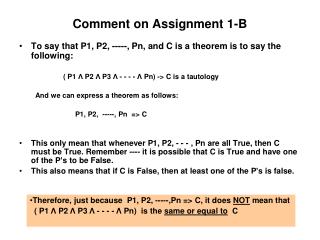
Comment on Assignment 1-B • To say that P1, P2, -----, Pn, and C is a theorem is to say the following: ( P1 Λ P2 Λ P3 Λ - - - - Λ Pn) -> C is a tautology And we can express a theorem as follows: P1, P2, -----, Pn => C • This only mean that whenever P1, P2, - - - , Pn are all True, then C must be True. Remember ---- it is possible that C is True and have one of the P’s to be False. • This also means that if C is False, then at least one of the P’s is false. • Therefore, just because P1, P2, -----,Pn => C, it does NOT mean that • ( P1 Λ P2 Λ P3 Λ - - - - Λ Pn) is the same or equal to C
Comment on Assignment 1-B (cont.) • We know that: a -> b, a => b (the modus ponens theorem) • Thus [ (a->b) Λ a ] -> b must be a tautology • But [ (a->b) Λ a ] may Not Equal b a b a-> b (a->b) Λ a [(a->b)Λa] ->b b-> [(a->b) Λ a] T T T T T T T F F F T T F T T F T F F F T F T T tautology not tautology thus [(a->b) Λ a] ≠ b Caution: Do not use the Replacement Rule to substitute the Conclusion for the Premises of a theorem because they are not equal !! (see Replacement Rule 2)
Forward/Backward Chaining approach(using only 2 symbols: R and O) P1 : open /\ receiving -> ~closed : (O/\R) -> O P2 : ~ open : ~O P3 : receiving -> closed : R -> ~O Concl : ~(receiving /\ open) : ~(R /\ O) Note: that Open is used for ~Closed and ~Open is used for Closed Legend: O - open R – receiving C – closed which same as ~O O R P1: O /\ R -> O P2: ~O P3: R -> ~O Concl: ~(R /\ O) (1) (2) (3) (4) T T T F F F F T F T T T T T F T T T F F T T T T Forward chaining : rows 3 and 4 where P1,P2,and P3 are all True and so is Conclusion Backward chaining: Concl is False in row 1 and at least one of the premises is also False
Forward/Backward Chaining approach(using 3 symbols: R, O, C) P1 : open /\ receiving -> ~closed : O/\R -> ~C P2 : ~ open : ~O P3 : receiving -> closed : R -> C Concl : ~(receiving /\ open) : ~(R /\ O) O - open R – receiving C - closed O R C P1: O /\ R -> ~C P2: ~O P3: R -> C Conc: ~(R /\ O) (1) (2) (3) (4) (5) (6) (7) (8) T T T F F T F T T F T F F F T F T T F T T F T T F T F T F T T T T T T F T F T T F T T T T T F F T F F F T T T T Forward chaining : P1,P2,and P3 are all True in rows 5,7 and 8; so is Concl Backward chaining: Concl is False in rows 1 and 2; at least one of the premises is also False
Manipulating Syntax (a la pages: 53-59 of text) • A Fairly “Simple Approach”: • (O/\R) -> ~C, ~O, R -> C ├ ~(R/\O) given problem • [ ((O/\R)-> ~C) /\ (~O) /\ (R ->C) ] -> ~(R/\O) inference, p55 • ~ [ ((O/\R)-> ~C) /\ (~O) /\ (R ->C) ] \/ ~(R/\O) implies law, p48 • ~ [ “ ] \/ ~R \/ ~O DeM law, p47 • [~ ((O/\R) -> ~C) \/ ~(~O) \/ ~(R->C) ] \/ ~R \/ ~O DeM law, p47 • ~ ((O/\R) -> ~C) \/ ~(~O) \/ ~(R->C) \/ ~R \/ ~O assoc law, p47 • ~((O/\R) -> ~C) \/ ~(R->C) \/ ~(~O) \/ ~R \/ ~O comm. law, p46 • ~ ((O/\R) -> ~C) \/ ~(R->C) \/ ~R \/ ~(~O) \/ ~O comm. law, p46 • [ ~((O/\R) -> ~C) \/ ~(R->C) \/ ~R ] \/ [~(~O) \/ ~O] assoc. law, p 47 • [ “ ] \/ [ O \/ ~O ] neg rule, p 47 • [ “ ] \/ TRUE exmid rule, p47 • TRUE or2 rule , p46
Manipulating Syntax (a la pages: 53-59 of text) • A “ Lengthier” Approach: • (O/\R) -> ~C, ~O, R -> C ├ ~(R/\O) given problem • [ ((O/\R)-> ~C) /\ (~O) /\ (R ->C) ] -> ~(R/\O) inference, p55 • (~(O/\R) \/ O) /\ (~O) /\ (R->C) -> “ note : replace ~C with O • ( (~O\/~R) \/ O) /\ “ -> “ DeM rule • (~O \/ ~R \/ O) /\ “ -> “ assoc. rule • (~R \/ ~O \/ O) /\ “ -> “ comm rule • (~R \/ True ) /\ “ -> “ exmid • True /\ “ -> “ or 2 rule • True /\ (~O) /\ (R -> ~O) -> “ note : replace C with ~O • True /\ ~O /\ (R-> ~O) -> “ • ~O /\ (R-> ~O) -> “ and 2 rule • ~O /\ (~R \/ ~O) -> “ impl rule • (~O /\ ~R) \/ (~O /\ ~O) -> “ dist. Rule • (~O /\ ~R ) \/ (~O) -> “ and 1 rule • ~(O \/ R) \/ (~O) -> “ DeM rule • ~ [ (O\/R) /\ O ] -> “ DeM rule • ~[ (O/\O) \/ (R/\O) ] -> “ distr. Rule • ~ [ O \/ (R/\O) ] -> “ and 1 rule • ~ { ~ [O \/ (R/\O) ] } \/ ~(R /\ O) impl rule • [ O \/ (R/\O) ] \/ ~(R/\O) neg rule • O \/ (R/\O) \/ ~(R/\O) assoc rule • O \/ True exmid rule • True or 2 ~O /\ ~ (R /\ O) DeM rule ~ [ O v (R /\ O) ] DeM rule
Solution borrowed from student, Carolyn (spring ’08) Let O= open ; R=receiving ; C= closed Problem: Show that: (OΛR -> ~C), ~O, (R->C)├ ~(RΛ O) Premise: (OΛR -> ~C), ~O, (R->C) are all True • Solution: • Show that { (OΛR -> ~C) Λ ~O Λ(R -> C) } -> ~(RΛ O) is a tautology • {(OΛR -> O) Λ ~O Λ (R -> ~O)}-> ~(RΛ O):substituting O = ~C • {[(OΛR -> O) Λ ~O] Λ (R -> ~O)}-> ~(RΛ O) : assoc. law • { TRUE Λ ~O Λ (R -> ~O)} -> ~(R ΛO) : a Λ b -> a is a tautology • finish as previous page (from step 8 of previous page and go down)
Solution borrowed from student (Rick - Spring2012) Let O= open ; R=receiving ; C= closed Problem: Show that: (OΛR -> ~C), ~O, (R->C)├ ~(RΛ O) Premise: (OΛR -> ~C), ~O, (R->C) are all True • Start with the conclusion : ~(R Λ O) • via DeMorgan, convert to : ~ R V ~ O • We know ~ O is True given above: ~R V TRUE • (Anything V TRUE) : TRUE