Download
1 / 4
40 likes | 150 Views
This overview delves into the foundational aspects of diffusion, particularly Brownian motion, as illustrated by Robert Brown's seminal observations in the 19th century. It explores the behavior of pollen particles and the active molecules in various substances, emphasizing the implications of diffusion in healthy tissues and conditions impacting water movement, such as hypercelularity and extracellular fibrosis. The role of advanced MRI techniques in studying diffusion-weighted imaging is also discussed, shedding light on the complex dynamics of molecular movement in biological systems.

E N D
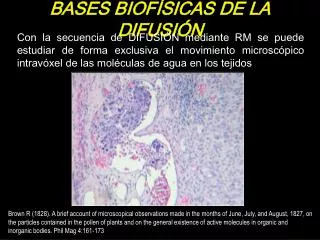
BASES BIOFÍSICAS DE LA DIFUSIÓN Brown R (1828). A brief account of microscopical observations made in the months of June, July, and August, 1827, on the particles contained in the pollen of plants and on the general existence of active molecules in organic and inorganic bodies. Phil Mag 4:161-173 Con la secuencia de DIFUSIÓN mediante RM se puede estudiar de forma exclusiva el movimiento microscópico intravóxel de las moléculas de agua en los tejidos
DIFUSIÓN EN TEJIDO SANO H2O Doob JL (1942). The Brownian movement and stochastic equations. Ann Math 43:351-369
CAUSAS DE RESTRICCIÓN DE LA DIFUSIÓN Delande C, de Zwart JA, Trillaud H et al. An echo-shifted gradient-echo MRI method for efficient diffusion weighting. Magn Reson Med 1999; 41:1000-1008 El movimiento del agua se restringe por: • Hipercelularidad • Barreras físicas (membranas celulares íntegras, que son hidrofóbicas) • Tortuosidad del intersticio celular • Edema intersticial • Fibrosis extracelular
DIFUSIÓN EN LESIÓN HIPERCELULAR H2O Clark CA, Le Bihan D (2000). Watter diffusion compartmentation and anisotropy at high b values in the human brain. Magn Reson Med Dec; 44 (6):852-859