Induction and Mechanisms of Cytochrome P450 and Phase II Drug Metabolism
This text discusses the induction of cytochrome P450 (CYP) enzymes and Phase II metabolism, highlighting the increased transcription and protein synthesis in response to various inducers. It details constituent and inducible CYP forms such as CYP1A1, CYP2B, and CYP3A4, along with the role of the Aryl Hydrocarbon Receptor (AhR) in mediating gene transcription. Additionally, it explores major Phase II reactions including glucuronidation, sulfation, conjugation, and their importance in detoxifying xenobiotics. Key receptors and enzymes involved in these pathways are also outlined.

Induction and Mechanisms of Cytochrome P450 and Phase II Drug Metabolism
E N D
Presentation Transcript
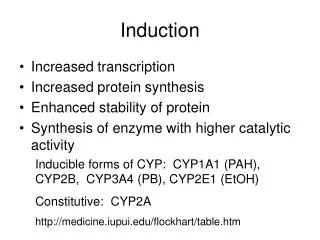
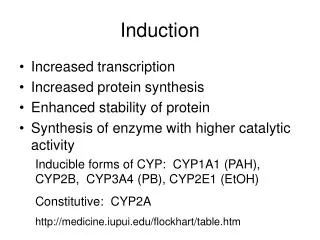
Induction • Increased transcription • Increased protein synthesis • Enhanced stability of protein • Synthesis of enzyme with higher catalytic activity Inducible forms of CYP: CYP1A1 (PAH), CYP2B, CYP3A4 (PB), CYP2E1 (EtOH) Constitutive: CYP2A http://medicine.iupui.edu/flockhart/table.htm
Example: AhR, receptor in cytoplasm, binds ligand: eg PAHs, TCDD, some PCBs Bound AhR loses 2 heat-shock proteins (hsp90), becomes phosphorylated Activated bound AhR migrates to nucleus, forms complex with Ah receptor nuclear translocation factor Arnt AhR-Arnt complex binds to regulatory sequences in DNA (DRE, dioxin-responsive elements) Transcription of CYP1A1 gene and other genes Ah-locus mediated induction
Other “inducers” also interact with receptors • CAR, responds to phenobarbital-type inducers, regulates CYP2B, CYP3A4, CYP reductase, transferases (?) • PXR, CYP3A • PPARα, CYP4A • LXR, FXR control enzymes involved in bile acid and lipid metabolism
Phase II: Conjugation • Synthetic reaction of a xenobiotic (or of a Phase I metabolite of a xenobiotic) with an endogenous substance • Results in introduction of polar, ionizable groups to enhance water solubility and hence excretion
Major Phase II reactions • Glucuronidation • Sulfation • Conjugation with amino acids • Conjugation with glutathione • Methylation • Acetylation
Glucuronidation • Enzyme: glucuronyl transferase, or glucuronosyl transferase • Targets: • hydroxyl groups: Phenols, Alcohols, Dihydrodiols (ether glucuronides) • Carboxylic acids (ester glucuronides) • Amines (N-glucuronides) • Thiols (S-glucuronides) • Carbon (C-glucuronides, rare)
Reaction Phenol Phenyl glucuronide
Glucuronidation • Conjugating moiety: glucuronic acid, a sugar • Co-factor: UDP-glucuronic acid (UDPGA), derived from glycogen synthesis • Located in endoplasmic reticulum • Multiple families of isoforms:UGT1, UGT2 • UGT1.1 ..1.7, UGT2.1..2.4 • Inducible
GlucuronidationTypical substrates: • Phenol • 1-Naphthol • 4-Hydroxybiphenyl • 3-Hydroxybenzo[a]pyrene • Benzo[a]pyrene-7,8-dihydrodiol • 2-Naphthylamine • Bilirubin • Steroids
Sulfation • Sulfotransferase ST,15 isoforms (xx-ST) • Targets • Hydroxyl groups (phenols, alcohols) • Amino groups • Thiols • Conjugating moiety: sulfuric acid, H2SO4 • Co-factor: 3’phosphoadenosine 5’phosphosulfate (PAPS), formed from ATP + sulfate • Located in cytosol, Probably not inducible
SulfationTypical substrates • Ethanol • Phenol • 3-Hydroxybenzo[a]pyrene • Cholesterol • 2-Naphthylamine • N-hydroxy-2-naphthylamine
Reaction PAPS PAP
Conjugation with amino acids • Amino acid transferases • Targets: carboxylic acids • Conjugating moieties: Glycine, glutamine, alanine, taurine, histidine, ornithine • Co-factor: Acetyl CoA (CoASH) and ATP • In cytosol
Reaction Benzoyl-CoA Hippuric acid Benzoic acid
Conjugation with glutathione • Glutathione S-transferases (GST) • Targets: Epoxides, halogens • Conjugating moiety: Glutathione • Co-factor: None • Mainly in cytosol • Inducible • Multiple families of isoforms: GSTA, GSTM, GSTP, GSTT ()(αμπθ)
Glutathione A tripeptide Glutamic acid (Glu) Glycine (Gly) Cysteine (Cys)
Typical substrates • Organic halides, e.g methyl iodide, benzyl chloride • Alkenes e.g. diethyl maleate • Epoxides