Mastering Present Simple: A Fun Day with English Grammar
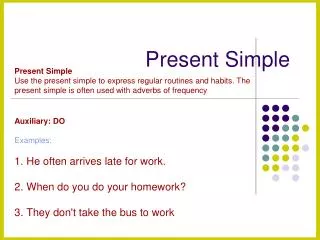
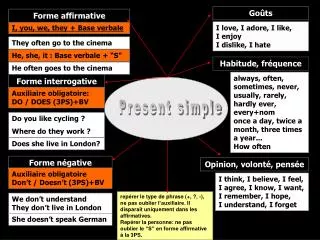
Dive into the intricacies of the Present Simple tense with "Spotlight 3." This engaging module provides a comprehensive overview of how to express habits and general truths, along with the usage of auxiliary verbs 'do' and 'does.' You'll explore grammatical structures and practice translating sentences from Russian to English. Gain confidence in forming negative and interrogative sentences while learning essential vocabulary. Suitable for learners eager to refine their English language skills, this module is an exciting step in your language journey!

Mastering Present Simple: A Fun Day with English Grammar
E N D
Presentation Transcript
УМК “Spotlight 3” («Английский в фокусе») Н.И. Быкова, Д. Дули, М.Д. Поспелова, В. Эванс Present simple Module 8. a fun day!
He speaks Chinese and Japanese with equal ease.
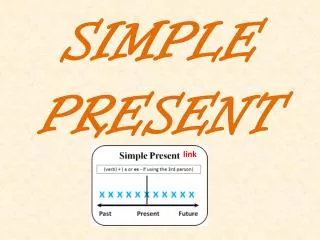
He speaks Chinese and Japanese with equal ease. • В этом предложении использовано грамматическое время … • 2. Мы используем это время для … • действий, говоря о привычках, а также для выражения ситуации в целом. • 3. Окончание –s добавляется к глаголам … Present Simple (настоящее простое) повторяющихся 3-го л. ед. ч.
Add –s/-es to the verbsДобавь к глаголам окончание –s/-es • play • paint • wash • make • fix • watch • go • fly • eat • dress • plays • paints • washes • makes • fixes • watches • goes • flies • eats • dresses
Вспомогательный глагол используется в отрицательных и вопросительных предложениях. [du:] [dʌz]
Вспомогательный глагол do Вспомогательный глагол do используется c местоимениями I, you, we, they. + - ? We have English every Thursday. don’t We have English every Thursday. do Yes, we . No, we . Do we have English every Thursday? don’t
Translate from Russian into English Переведите с русского на английский 1. Я не хожу в школу по воскресеньям. 2. Ты любишь мороженое? – Да. 3. Твои друзья играют в компьютерные игры? – Нет. I don’t go to school on Sundays. Do you like ice cream? – Yes, I do. Do your friends play computer games? – No, they don’t.
Вспомогательный глагол does Вспомогательный глагол does используется с местоимениями he, she, it. + - ? She likes chocolate. doesn’t She like chocolate. does Yes, she . No, she . Does she like chocolate? doesn’t
Translate from Russian into English Переведите с русского на английский 1. Он не смотрит мультфильмыво вторник. 2. Твой кот любит молоко? – Да. 3. Твой друг играет в теннис? – Нет. He doesn’t watch cartoonson Tuesday. Does your cat like milk? – Yes, it does. Does your friend play tennis? – No, he doesn’t.
make the sentences negativechoose don’t/doesn’t • I speak English very well. • You like to read. • We play chess on Mondays. • He swims very well. • She watches films every Tuesday. • It likes milk. • They listen to music every day. • I don’t speak English very well. • You don’t like to read. • We don’t play chess on Mondays. • He doesn’t swimvery well. • She doesn’t watch films every Tuesday. • It doesn’t like milk. • They don’t listen to music every day.
Choose do or doesвыберите do/don’t или does/doesn’t don’t • I ______ like cheese, yuk! • _____ your mother cook breakfast every morning? – Yes, she _____ . • He _____ sing songs on Mondays. • We _____ have English on Fridays. • _____ they go to the supermarket every week? – No, they _____ . Does does doesn’t don’t Do don’t
complete the questionschoose do/does, don’t/doesn’t • _____ you like ice cream? – Yes, I _____. • _____ your father speak French? – No, he _______. • _____ she cook well? – Yes, she _____. • _____ they play games every day? – No, they ______. • _____ it run fast? – Yes, it _____. • _____ we study well? – Yes, we _____. • _____ your sister live with you? – Yes, she _____.
Present Simple: do/does check yourself • Вспомогательные • глаголы используются в: • утвердительных предложениях; • отрицательных предложениях; • вопросительных предложениях. Проверь свои знания • Вспомогательный глагол DO употребляется с местоимениями: • I; • you, we, they; • he, she, it. • Вспомогательный глагол DOES употребляется с местоимениями: • I; • you, we, they; • he, she, it.
Выполнила:Гречушкина Ю.А. учитель английского языка, Лицей № 15, г. Саров