Understanding Energy Measurements: Newtons, Joules, and Watts in Canadian Households
This article explores the fundamental concepts of energy measurements including Newtons, Joules, and Watts. It highlights energy consumption in Canada, noting that households used 1,425 petajoules in 2011. The text defines Newton as the unit of force, Joule as the unit of energy/work, and Watt as the unit of power. The relationship between these units is explained, showcasing their practical applications. For instance, one Joule is the energy required to lift an apple, while Watts signify the rate of energy use, such as in household appliances.

Understanding Energy Measurements: Newtons, Joules, and Watts in Canadian Households
E N D
Presentation Transcript
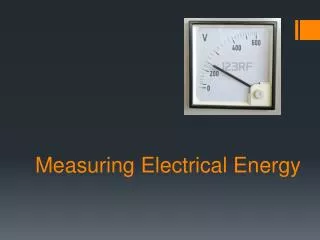
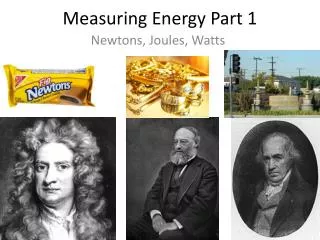
Measuring Energy Part 1 Newtons, Joules, Watts
Energy Use in Canada • Canadian households used 1,425 petajoules of energyin 2011(StatsCan) • 1 petajoule is approximately the amount of energy needed to run the TTC subway for one year
Newton (N) • SI unit of FORCE • Force is a push or pull against an object • 1 Newton is the amount of force needed to accelerate a mass of 1 kg by 1 meter/s2 N = kg x m/s2 A newton will move 1 kg of weight • one meter in the first second, • 2m in the second second • 3m in the third second
Newton (N) 1 KG 1 KG 1 KG 1 KG 1 KG 1 KG Time 1 Second 2 Seconds 3 Seconds
Joule (J) • SI unit of energy and work • Energy is the ability to do work • Work is the energy transferred when a force moves an object • 1 joule is the work done/energy transferred when 1 newton of force moves an object 1m. J = N x m (N=newton, m=meter) One joule equals the energy needed to lift an apple from the floor to the tabletop, about 1m.
Watt (W) • The SI unit of power • Power is the rate at which work is done • One watt is equal to 1 joule of energy produced per second W = J/s (j=joule, s=sec)
Watt hours (Wh) • Light bulbs are rated according to the power they use • this is measured in Watt hours (Wh). Since there are 3600 (60 x 60) seconds in an hour one watt hour = 3 600 joules of energy • A 20 watt lightbulb uses 20 watts of power in an hour. • A 20 watt bulb uses 3 600 X 20 = 72 000 joules of energy
Kilowatts (KW) • 1000 Watts is a kilowatt (KW) • A kilowatt hour (KWh) is equal to 1000 watt hours (Wh) One KWh = 1000 watt hours 1000 watt hours = 1000 x 3 600 = 3 600 000 joules