Understanding Stellar Structure: HR Diagram and Physical Principles
Dive into the fundamentals of stellar structure with a focus on the Hertzsprung-Russell (HR) diagram, which plots luminosity against temperature for over 22,000 nearby stars, as measured by the Hipparcos mission. Explore the classification of stars by spectral types, including helium, titanium oxide, and calcium. Learn about hydrostatic equilibrium and radiative transfer in stars, alongside detailed density and temperature profiles. This comprehensive overview provides insights into the life cycles of stars, including examples like the Pleiades cluster and models of young star clusters.

Understanding Stellar Structure: HR Diagram and Physical Principles
E N D
Presentation Transcript
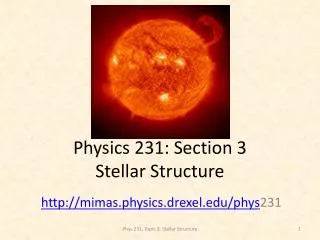
Physics 231: Section 3Stellar Structure http://mimas.physics.drexel.edu/phys231 Phys 231, Topic 3: Stellar Structure
HR Diagram of 22,000 nearby stars Parallaxes measured from Hipparcos Phys 231, Topic 3: Stellar Structure
Spectral Types HeI 3819 TiO CaI Balmer beta Phys 231, Topic 3: Stellar Structure
Radius on the HR diagram Phys 231, Topic 3: Stellar Structure
Luminosity Classes of Stars Phys 231, Topic 3: Stellar Structure
The Pleiades Phys 231, Topic 3: Stellar Structure
Model HR diagram of a 10 Myr old star cluster Phys 231, Topic 3: Stellar Structure
Hydrostatic Equilibrium • Just like in Freshman physics, make the forces cancel! Pressure above Layer of Gas Gravity Pressure below Phys 231, Topic 3: Stellar Structure
From xkcd Phys 231, Topic 3: Stellar Structure
Radiative Transfer Radiation from below Less Dense Layer (low kappa) Dense Layer (high kappa) Radiation from below Phys 231, Topic 3: Stellar Structure
Detailed Density/Temperature profiles of the sun Screen Captured from Martin Weinberg’s stellar app. Link is On the course website. Phys 231, Topic 3: Stellar Structure