Understanding Data and Statistics: Foundations for Research and Informed Decision-Making
This overview introduces data and statistics, essential tools for gaining knowledge across various fields. It covers data sources, including surveys and experiments, and explains statistical methods for designing studies, summarizing data, and making inferences about larger populations based on samples. The importance of representative samples and the use of statistical software for data analysis are highlighted. Understanding statistics equips individuals to interpret research findings in psychology, medicine, and business, offering a competitive edge in today’s data-driven job market and aiding critical thinking in daily life.

Understanding Data and Statistics: Foundations for Research and Informed Decision-Making
E N D
Presentation Transcript
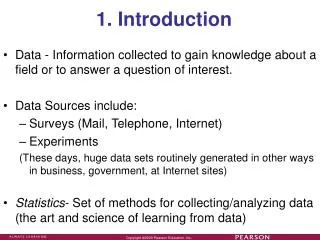
1. Introduction • Data - Information collected to gain knowledge about a field or to answer a question of interest. • Data Sources include: • Surveys (Mail, Telephone, Internet) • Experiments (These days, huge data sets routinely generated in other ways in business, government, at Internet sites) • Statistics- Set of methods for collecting/analyzing data (the art and science of learning from data)
Statistics provides methods for: • Design - Planning/Implementing a study • Sample survey or experiment? • How to choose people (subjects) for the study, and how many? • Description – Graphical and numerical methods for summarizing the data • Inference – Methods for making predictions about a population (total set of subjects of interest), based on a sample (subset of the sample on which study collects data)
Examples • How can we study whether a new therapy is better than a standard therapy for treating depression? • How (if at all) is happiness associated with income, job satisfaction, family situation, social life, religious beliefs, political ideology? • Can we predict college GPA using IQ, average time studying per week, high school GPA, SAT scores, number of hours spent on social activities, … ?
Parameter – Numerical summary of the population • Population mean (or median or some other measure) • Population proportion (or percentage) • Statistic – Numerical summary of the sample We’ll learn how to use sample statistics to make inferences about population parameters.
Parameter % of all adult Americans who approve of Barack Obama’s performance as President Mean reaction time to red light in experiment when using (not using) cell phone while driving (conceptual population) Statistic % of 1000 adult Americans in a poll who approve of Obama’s performance as President Mean reaction time to red light for 100 students in experiment when using (not using) cell phone while driving Examples: parameters / statistics
Note: • Populations can be actual sets of people or conceptual (hypothetical) • For good inferences, need sample to be representative of population • Statistical software (such as SPSS, Stata, SAS, R, Minitab) is used to analyze data
Software applies to data files • Any one row contains observations for particular subject (person) in sample • Any one column contains observations for a particular characteristic (“variable”) measured. The names of the characteristics are at top of file, in first row.
Examples: Go to www.stat.ufl.edu/~aa/social/data.html The first data file, from a survey of 60 social science graduate students at Univ. of Florida, looks like: subject gen age high coll tv veg party ideology abor 1 m 32 2.2 3.5 3 n r 6 n 2 f 23 2.1 3.5 15 y d 2 y 3 f 27 3.3 3.0 0 y d 2 y 4 f 35 3.5 3.2 5 n i 4 y 5 M 23 3.1 3.5 6 n i 1 y
Why study Statistics? One answer: You need it to understand research findings in psychology, medicine, business, ….. Another answer: In a competitive job market, understanding how to deal with quantitative information provides an important advantage. (“The sexy job of the next 10 years will be statistician” – Hal Varian, chief economist at Google) Broader answer: In your everyday life, it will help you make sense of what to heed and what to ignore in statistical information provided in news reports, medical research, surveys, political campaigns, advertisements, …