Download
1 / 6
60 likes | 220 Views
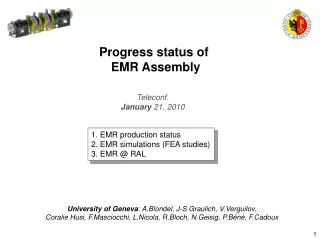
Between 2009 and 2010, the EMR program significantly expanded, marked by the hiring of a new Scholar Scientist in biochemistry and a push into biochemistry, signaling future acquisition of HiPER. Key advancements include the introduction of the world's highest frequency pulsed EPR spectrometer at 336 GHz and the expansion of continuous frequency coverage to 1 THz. Despite a surge in user engagement and high-quality publications, there remains a pressing need for increased staffing support to maintain effective user assistance and foster further proposal and instrument development.

E N D
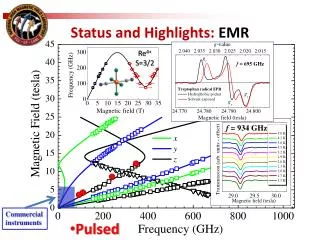
Re4+ S=3/2 Status and Highlights: EMR f = 934 GHz Commercial instruments • Pulsed
Program growth in 2009 - 2010: • Hiring of a new Scholar Scientist in biochemistry* • New push into biochemistry (future acquisition of HiPER)* • Many new users, and increased numbers of users* • World’s highest frequency pulsed EPR spectrometer (336 GHz) • Expanded continuous frequency coverage to 1 THz (35 T for g=2)* • High resolution EPR increased to 700 GHz in 25 T Keck magnet* • Addition of Mössbauer spectroscopy to user instrumentation • Development of EPR under pressure (separate NSF CHE funding) • ~10% of NHMFL publications (~40 per year) • Quality publications (past 2 years): JACS 11; PRL 9; Nature Mat. 1; • Nature Phys. 1; PNAS 1; PRB 9; Inorg. Chem. 18; Dalton 5; Biochem. 1. • *Specifically discussed in the previous renewal proposal Status and Highlights: EMR Milestones:
EMR growth: High-resolution HFEPR Tryptophan (Trp) radical in azurin, an electron transfer protein S. Stoll, D. Britt UC Davis • g tensor characteristic of microenvironment . • Compare to electronic structure calculation. • Crucial for systems with small g anisotropy (tryptophans, tetra-pyrroles, e.g., chloro-phylls, and organic photovoltaic materials)
Magnetic atoms with strong spin-orbit coupling (5d, 4f, even 5f) • 1D single-chain magnet • Slow quantum dynamics JACS2010, 132, 3980 EMR growth: Molecular Nanomagnetism Re4+: [Xe] 4f14 5d3 S = 3/2 T = 1.3 K
Existing sources + new magnets (SCH/split-gap) • Will require improved 1+ THz probes • Future sources (BigLight) & highest fields (60 T) • 1Short-term; 2longer-term Future growth: Ultra-high fields/frequencies Low-loss quasi-optics & corrugated waveguide All-optical HF-EPR in split-gap magnet(s) Series connected hybrid Split- Gap magnet
Significant growth in program has so-far occurred without a corresponding growth in the number of postdocs and students • This is taking its toll on the user support staff • More and more time devoted to user support • Less time on proposal and instrument development • Increased staffing support needed EMR growth: personnel/staffing