Download
1 / 6
60 likes | 169 Views
This presentation by Vinod Dhall from Dhall Law Chambers, in collaboration with Linklaters LLP, provides an in-depth analysis of the concept of dominance within the framework of the Indian Competition Act. It elaborates on defining dominance, the factors affecting market power, and highlights prohibited abusive practices, including unfair pricing and predatory strategies. The discussion also covers possible remedies for abuse of dominance, including penalties, cease-and-desist orders, and the implications for affected parties. This primer is essential for anyone studying or practicing competition law in India.

E N D
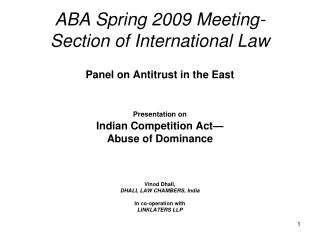
ABA Spring 2009 Meeting-Section of International Law Panel on Antitrust in the East Presentation on Indian Competition Act— Abuse of Dominance Vinod Dhall, DHALL LAW CHAMBERS, India In co-operation with LINKLATERS LLP
What is dominance? • Position of strength in relevant market enabling enterprise to: • Operate independently, or • Affect competitors, consumers, market in its favour • Factors to be considered include: • Market share; no threshold prescribed • Entry barriers • Size and resources of enterprise • Size and importance of competitors • Vertical integration • Countervailing power • Others
Abuse • Dominance itself not prohibited, but is objective condition or abuse • Abuse of dominance by enterprise (or by group) prohibited • Following practices shall be abuse: • Imposing unfair or discriminatory condition or price • Limiting production, technical or scientific development • Denial of access • Supplementary, unconnected obligations • Using dominance in one market to enter/protect other market • Predatory pricing
Remedies • Cease and desist order • Penalty up to 10% of turnover ( global) • Order for division of dominant enterprise • Any other order / direction • Injured parties may bring follow-on damages claims before Appellate Tribunal • Commission can punish for contravention of its orders/ directions • Individual employees also liable • No private enforcement
Comments • Wording similar to EC Art 82 • But, list of abuses is exhaustive • Formulation is form based • But, includes ‘meeting competition’ defence • Predatory pricing- no recoupment requirement • No case law yet • Direction of future enforcement? • a form-based approach, or • competitive impact of unilateral conduct, • based not only on competitive factors
Vinod Dhall, Dhall Law Chambers, Dewan Manohar House, B-88, Sector 51, Noida, U.P., India-201301 Phone:+91-120-4547551, Fax:+91-120-4547550 Vinod.dhall@dhall-lawchambers.com, dhall.vinod1@gmail.com