Download
1 / 19
190 likes | 353 Views
This study session covers muscle tissue types including skeletal, smooth, and cardiac muscles. We will compare their structures, functions, and locations. Key learning objectives include understanding the effects of high-intensity resistance training on skeletal muscle and the mechanisms behind muscle hypertrophy. The lecture highlights essential characteristics such as irritability, contractility, extensibility, and elasticity. We will engage in practice questions and discussions to reinforce the material, including muscle cells, connective tissue sheaths, and their physiological roles.

E N D
Review lecture notes. Review Wrap-up practice questions. Study diagrams discussed today. Chap 9 Muscle Tissue Intro Learning Objectives: Compare & contrast the basic types of muscle tissue. Describe the characteristics of each muscle type. 3. Explain the effects of high intensity resistance exercise on skeletal muscle.
DISCUSSION • Besides skeletal muscle (like we’ve seen on the previous slide), what are the other types of muscle in the body? Where are these other types found?
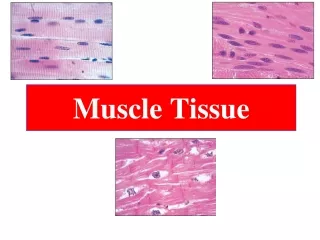
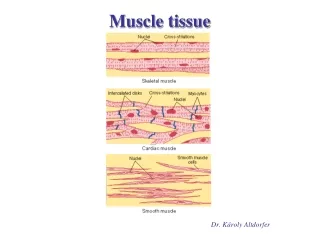
Muscle Overview • Three types of muscle tissue: _______, ______________, and ___________. These differ in structure, function, and location. • “Mus” (in the word muscle) means _________________ in Latin • “Myo” or “Sarco” refers to ________
Muscle Similarities • Skeletal and smooth muscle cells are elongated and are called _____________. • Muscle contraction depends on two kinds of myofilaments – _____ and _______. • Muscle terminology is similar • Sarcolemma – muscle plasma __________ • Sarcoplasm – __________ of a muscle cell
Characteristics of Muscle Tissue • _________ or irritability – the ability to receive and respond to stimuli • _________ – the ability to shorten forcibly • __________ – the ability to be stretched or extended • __________ – the ability to recoil and resume the original resting length
Muscle Functions • Skeletal muscles are responsible for all ___________ • ________ muscle is responsible for coursing the blood through the body • ________ muscle helps maintain blood pressure, and squeezes or propels substances (i.e., food, feces) through organs • Muscles also maintain ________, stabilize _______, and generate heat
Quick Check 1. What are the 3 types of muscle tissue? 2. Muscles functions include maintaining ________, stabilizing _______, and generating _______
Skeletal Muscle • Packaged in skeletal muscles that attach to and cover the bony _________ • Has obvious stripes called _________ • Is controlled _________ (i.e., by conscious control) • Contracts ______ but tires _______ • Is responsible for overall body _________ • Is extremely adaptable and can exert forces ranging from a fraction of an ounce to over __ pounds
Skeletal Muscle continued • Each muscle is a discrete ________ composed of muscle tissue, blood vessels, nerve fibers, and connective tissue • The three connective tissue sheaths are: • ____mysium – fine sheath of connective tissue composed of reticular fibers surrounding each muscle fiber • _____mysium – fibrous connective tissue that surrounds groups of muscle fibers called fascicles • ____mysium – an overcoat of dense regular connective tissue that surrounds the entire muscle
Label your practice diagram with the 3 connective muscle sheaths (circles in red)plus striations Striations (stripes)
Skeletal Muscle • Each ________ is served by one nerve, an artery, and one or more veins • Each skeletal muscle fiber is supplied with a nerve ending that controls __________ • Contracting fibers require continuous delivery of oxygen and nutrients via ________ • Wastes must be removed via ______
Skeletal Muscle Attachments Most skeletal muscles span joints and are attached to bone in at least two places. ______ - the point or mode of attachment of a skeletal muscle to bone or other body part that moves • ________ - end of the muscle that is attached to a bone that does not move when the muscle contracts
Muscle Attachment continued Muscles attach: • __________ – epimysium of the muscle is fused to the periosteum of a bone • __________ – connective tissue wrappings extend beyond the muscle as a tendon
Quick Check 1. What are striations? 2. The name of the muscle sheath surrounding the entire muscle?
Microscopic Anatomy of Skeletal Muscle Label the sarcolemma and myofibril only. - muscle plasma membrane - densely packed, rodlike contractile elements that make up most of the muscle volume
Smooth Muscle - Composed of spindle-shaped fibers with no _______________ - Have ________________ only (not other connective sheath layers) - Found in walls of hollow organs (except the heart) - Have essentially the same contractile mechanisms as skeletal muscle
Cardiac Muscle • Found in the walls of the _________ • Branching chains of cells with __________ • Endomysium is attached to the heart • ___________ control
Chap 9 Wrap-Up Practice • Complete the following questions for class discussion now. (*see handout) • Estimated time 10 – 12 minutes.