Understanding Density and Identifying Minerals: Key Concepts for Geology Students
Explore the fundamental principles of density calculation and mineral identification in geology. Learn how to calculate the density of a cube with a given volume and mass, and understand the criteria that define a mineral, including its chemical makeup. Discover the two main groups of minerals — silicate and nonsilicate — and how to identify minerals through their physical properties such as color, luster, streak, cleavage, fracture, hardness, and density. This comprehensive overview combines theory and practical applications for students in geology.

Understanding Density and Identifying Minerals: Key Concepts for Geology Students
E N D
Presentation Transcript
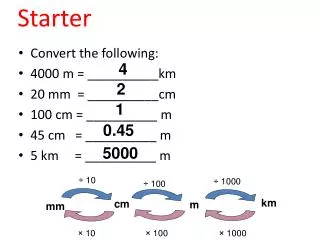
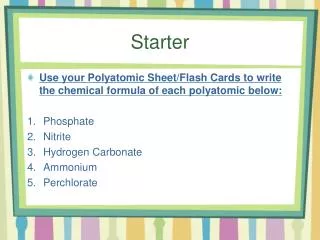
Starter: • What is the density of a cube with a side length of 3 cm and a mass of 27 grams?
Starter: • What is the density of a cube with a side length of 3 cm and a mass of 27 grams? • length = 3 cm, lxwxh = Volume, which equals? • Mass = 3 grams
Starter: • What is the density of a cube with a side length of 3 cm and a mass of 27 grams? • length = 3 cm, lxwxh = Volume, which equals 27 cm³ • Mass = 27 grams • Density = mass divided by volume = 1 g/cm³
Minerals Practice notes
Minerals: From the Inside Out • Minerals are the building blocks that make up rocks • There are about 3000 known minerals.
Answer These Questions • To be a mineral, all of the following questions must be answered “yes”: • Is it nonliving material? A mineral is inorganic. • Is it formed in nature? Only naturally made crystals are classified as minerals. • Does it have a crystalline structure (repeating inner structure that determines shape)? • Is it a solid? No gases or liquids allowed.
Two Groups of Minerals • Minerals are divided into two groups based on chemical makeup: • Silicate minerals – contain silicon & oxygen, with additional elements; make up more than 90% of Earth’s crust. • Nonsilicate minerals - no silicon or oxygen but C, O, Fe, S (carbonates – calcite, halides – fluorite, oxides – corundum, sulfates - gypsum
Silicate Minerals Quartz Feldspar Mica All silicate minerals contain the elements silicon and oxygen.
Nonsilicate Minerals CALCITE FLUORITE
Nonsilicate Minerals CORUNDUM GYPSUM
Identifying Minerals • 1. Color • Impurities can change color (quartz vs. amethyst) • Air and water can also change color of mineral (pyrite is golden, but exposure turns it black)
Color Quartz and amethyst are both silicon dioxide (SiO₂) but amethyst contains impurities which gives it its purple color.
Identifying Minerals (cont.) • 2. Luster • How the surface of a mineral reflects light. • Controlled by how atoms are bonded • Metallic, submetallic, nonmetallic (vitreous, silky, resinous, waxy, pearly, earthy)
Identifying Minerals (cont.) • 3. Streak • Color of mineral in powdered form • Not always the same color of mineral sample • More reliable than color of mineral Hematite may vary in color but the streak will always be reddish brown.
Identifying Minerals (cont.) • Cleavage and Fracture • How mineral breaks, determined by atomic arrangement • 4. Cleavage– tendency to break along flat surfaces (mica, halite) because bonding is weakest in those directions. • 5. Fracture – tendency to break along curved or irregular surfaces (quartz – conchoidal) when bonding is equally strong in all directions.
Identifying Minerals (cont.) • 6. Hardness • Resistance to being scratched • Mohs hardness scale: Talc, Gypsum, Calcite, Fluorite, Apatite, Orthoclase, Quartz, Topaz, Corundum, Diamond
Hardness Scratch Test • < 2.5 = Mineral marks paper • 2.5 = Fingernail • 3 = Copper Penny • 5 = Steel knife blade • 6 = Plate of glass • 6.5 = Steel file
Identifying Minerals (cont.) • 7. Density • How much matter there is in a given amount of space (D = m/v) (g/ cm³)
Identifying Minerals (cont.) • 8. Special Properties • Fluorescence (calcite, fluorite glow under UV) • Chemical reactions (calcite) • Optical – calcite causes double images • Taste – halite • Magnetism – magnetic, pyrrhotite attract iron • Radioactivity – minerals containing radium or uranium can be detected with a Geiger counter.
Elements and compounds Element- A substance that cannot be broken into simpler substances by chemical means. Found on the periodic table. Compound- A substance made of two or more different atoms that are chemically bonded.
Application: • Vocabulary foldable
Connection: Lab • Exit: in 3-5 sentences How would you describe the mineral that represents your birthday month, using the vocabulary from today’s lesson?