Download
1 / 18
180 likes | 327 Views
This paper explores non-blocking k-ary search trees, highlighting their structure, operational efficiency, and concurrent modification strategies. We delve into key operations such as insertion, deletion, and searching, along with the specific flags and marks used to manage concurrent modifications safely. Analysis of performance data shows promising efficiency in search and modification operations, with approximately 100-200 assists per 1000 operations in specific scenarios. Future directions for this research include enhancing balancing techniques and generalizing these non-blocking approaches to other data structures.

E N D
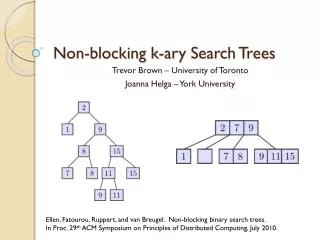
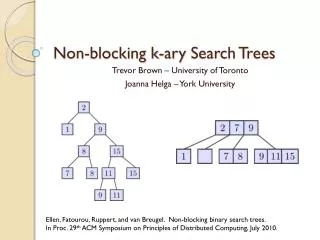
Non-blocking k-ary Search Trees Trevor Brown – University of Toronto Joanna Helga – York University Ellen, Fatourou, Ruppert, and van Breugel. Non-blocking binary search trees. In Proc. 29th ACM Symposium on Principles of Distributed Computing, July 2010.
k-ST data structure • Operations: Insert, Delete, Search • Leaf-oriented tree • Nodes have k children and k-1 keys
Updates to the structure • Two cases for Insert:
Updates to the structure • Two cases for Delete:
Danger of concurrent modifications • Concurrently: Delete(b), Insert(d)
Coordinating processes: flags and marks • Before a process can modify the tree: • If changing a child pointer of a node, it must flag the node (temporary) • If deleting a node, itmust mark the node* (permanent) • Can only flag or mark a node that is unflagged and unmarked.
Coordinating processes: helping • What if we try to flag or mark a node x that is already flagged or marked? • Flags and marks contain extra information • Read this information and help complete the update that flagged or marked x • Then retry our own operation from scratch
Coordinating processes:implementing flags, marks and helping • Consider Delete(9) on the following tree Flag: Pruning Delete(9) Clean Mark Clean
Coordinating processes:backtracking • Consider Delete(9) on the following tree • Insert(18) has already flagged a node Flag: Pruning Delete(9) Clean Flag: Insert(18) Clean
Performance data (1) • key range: [0, 106); 100% Search
Performance data (2) • key range: [0, 106); 8% Insert, 2% Delete
Performance data (3) • key range: [0, 106); 50% Insert, 50% Delete
How much helping actually occurs? Approx. 100-200 helps per 1000 operations for 4ST key range [0, 102), and roughly half as much helping for BST.
Future directions • Add balancing • Generalize these techniques • Other non-blocking algorithms • e.g., B+trees, priority queues