Understanding Solutions: Solvents, Solutes, and Their Properties
This guide explores the fundamental concepts of solutions, detailing the roles of solvents and solutes and their interactions. A solution is a well-mixed mixture where the solvent is present in the largest amount, dissolving the solute, which is present in a lesser amount. Key topics include the characteristics of concentrated and dilute solutions, the impact of temperature and pressure on solubility, and the differences between acids and bases. Learn about pH, neutralization reactions, and real-world examples such as saltwater and antifreeze.

Understanding Solutions: Solvents, Solutes, and Their Properties
E N D
Presentation Transcript
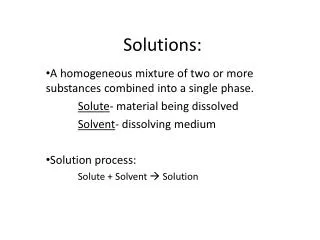
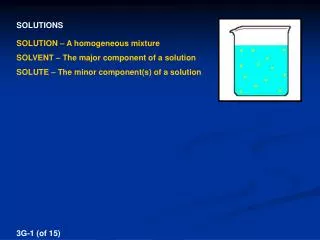
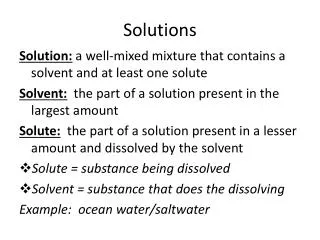
Solutions Solution: a well-mixed mixture that contains a solvent and at least one solute Solvent: the part of a solution present in the largest amount Solute: the part of a solution present in a lesser amount and dissolved by the solvent • Solute = substance being dissolved • Solvent = substance that does the dissolving Example: ocean water/saltwater
Colloids, Suspensions, & Solutions Colloid: a mixture containing small, undissolved particles that do not settle out. Examples: fog and milk – light can pass through Suspension: mixture in which particles can be seen and easily separated by settling or filtration. Example: snow globe • Solutes lower the freezing point and raise the boiling point of a solvent. • Example: water freezes at 0 degrees Celsius, salt water must be below 0 degrees Celsius to freeze • Example: Antifreeze in a car, reduces car from overheating from engine temperature/prevents engine from freezing in winter
Concentration and Solubility Concentrated solution: a mixture that has a lot of solute dissolved in it Example: sap from tree to make syrup Dilute solution: a mixture that has only a little solute dissolved in it Example: actual syrup • To measure concentration, you compare the amount of solute to the amount of solvent or the total amount of solution
Solubility continued… Solubility: a measure of how much solute can dissolve in a solvent at a given temperature Saturated solution: a mixture that contains as much dissolved solute as is possible Unsaturated solution: a mixture that contains less dissolved solute than is possible • Think about making lemonade (the pucker effect vs. I can’t taste anything) • Factors that affect solubility: Pressure, Temperature, and type of solvent Supersaturated solution: a mixture that has more dissolved solute than is predicted by its solubility at the given temperature.
Acids vs. Bases Acid:a substance that tastes sour, reacts with metals (corrosive – “eat away materials), and turns blue litmus paper red (Example: lemon) ***Never taste chemicals to identify them*** Base: a substance that tastes bitter, feels slippery, and turns red litmus paper blue (remember: Bases turn Blue) *See uses of acids and bases on pages 102-103
Acids, Bases, and the pH scale • An acid is any substance that produces hydrogen (H+) ions in water. • Hydrogen ion is an atom of hydrogen that has lost its electron. • Base is any substance that produces hydroxide ions (OH-) in water. • Hydroxide is a negative ion, made of oxygen and hydrogen pH Scale is a key used to measure the concentrations of ions. Ranges from 0-14 0 = extremely acidic 14 = extremely basic • Neutralization reaction: when an acid and base are mixed producing a Salt and Water