Exploring Plate Tectonics: The Dynamic Movement of Continents
Dive into the fascinating world of plate tectonics, where Earth's continents are in constant motion. Learn about the Earth's internal layers, including the crust, mantle, and core, and discover how seismic waves reveal the planet's composition. Unravel the historical significance of continental drift theory and the evidence of Pangea. Understand different types of plate boundaries—divergent, convergent, and transform—and their role in geological phenomena like earthquakes and volcanic activity. Join us as we explore the forces shaping our planet!

Exploring Plate Tectonics: The Dynamic Movement of Continents
E N D
Presentation Transcript
PLATE TECTONICS UPPS! MY CONTINENT IS MOVING…
Compositionallayers • Crust: dense rocks, rich in silicon and alumninium. (Granite in Continental crust, basalt in oceaniccrust) • Mantle: denserrocks, peridotite and magnesium • Core: iron
Physicallayers • Lithosphere: rigidsurface • Asthenosphere: ductile and partiallymolten • Lowermantle: solidbut flexible and ductile • Core: moltenouterlayer and a solidinnerpart.
Seismicdiscontinuities • There are twotypes of internalseismicwaves: • Primarywaves (P): thefastest and thefirsttoreachthesurface. Theymovethroughsolid and liquids. • Secondarywaves (S): slower and movetrhroughsolids. Seismometers record vibrationscausedbyseismicwaves. Changes in thewavesspeedindicate a change in thecomposition of the material they’re travelling through.
Discontinuityboundaries • TheMohorovicicdiscontinuity: (MOHO) Marks theboundarybetweencrust and mantle. • The Gutenberg discontinuity: S-wavescan’ttravelanyfurther and desappear, but P-waves are strongly refractes and slowdown. Limitbetweenmantle and outercore.
Themovement of continents • XIX and XX centuries: controversyaboutthe geological hisotory of continents. • Alfred Wegener(Germanmeteorologist) collectedevidencestoexplainthesimilarities in theshape of African and South American coastlines. Theory of Continental drift (1912).
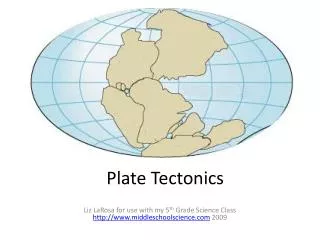
Continental DriftTheory • Continents, made of lightercrust, slidover a continuousthickerlayer. Thislayermade up theoceanfloor and continuedunderthecontinents. • Around 200 m y ago, allthecontinentswerejoinedforminPangea (thewholeEarth)
Evidencestoprovetheexistence of Pangea • Paleolithicevidence: identicalfossils of land-basedorganisms. • Geological evidence: continentsfitalongtheircoastlines and continental shelves. • Paleoclimaticevidence: glacial morraines in thecontinentsthatweresituated in thesouth pole of Pangea.
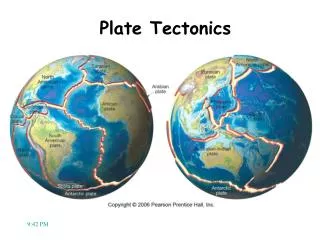
TheTheory of PlateTectonics • Seismic and volcanicbelts: earthquakeswerelocated in narrowbandswhichalsocontainareaswherevolcanoes are concentrated. • The geological activitycausedbytheEarth’sinternalenergyisconcentrated in trenches, mid-oceanridges and youngmountainranges.
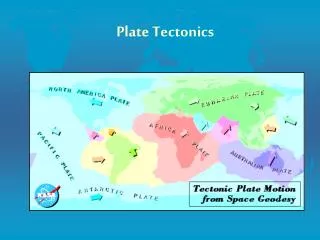
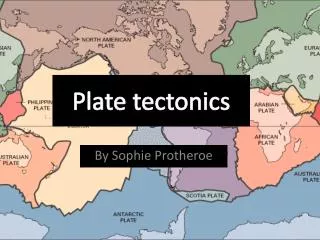
Lithosphericplates • A lithosphericplateis a fragment of thelithosphere. Eachplateisseparatedby a seismicbelt. • Classificationcriteria: • Size: 8 large and manymicroplates • Type of lithosphere: oceanic, continental, and mixedplates. • Dependingontheboundariesthere are varyinglevels of risk of Earthquakesorvolcanoeseruptionsoccurring.
Types of plateboundaries(edges): • Divergentboundaries (constructive): zoneswheretwoplatesmoveaparttocreate a new oceaniclithosphere. Ex: Mid-atlanticridge • http://www.kidsgeo.com/geology-for-kids/0045-divergent-boundaries.php
Convergentboundaries (destructive): zoneswheretwocontinentscollideorsubductionzoneswheretheoceanfloorgoesintothemantle. The Mariana Trench in thePacificOcean. • http://www.kidsgeo.com/geology-for-kids/0046-convergent-boundaries.php
Transformboundaries (passive): these are fractures , or transforma faultswheretwoplatesslidehorizontallyaganisteachother. (Seismicactivity)
http://www.kidsgeo.com/geology-for-kids/0044-plate-boundaries.phphttp://www.kidsgeo.com/geology-for-kids/0044-plate-boundaries.php
Subductionzones • Itoccurs at trencheswhenanocanplatecollideswithanotherplate and isforceddownintothemantle. Types: • Subductionunderthe continental lithosphere: anandeanmontainrangeisformedor more material isaddedtothelandmass. West coast of SourhnAmerica • Subductionundertheoceaniclithosphere: itcreatesanarc of volcanicislandsontheupperplate. Pacificislands
Theoceanfloor • 1960:oceanographic surveyships: Oceanfloormappingusingsonar • Details of theoceanfloor: • Mid-oceanridge: it has a central channelknown as a rift, crossedby perpendicular fractures calledtransformfaults. • Trenches: narrow and deepchannelsfoundnexttocontinentsorvolcanicislandarcs.
Theoceanfloorismade up of volcanicrockscovered in marine sediments. Theserocks are veryyoung, lessthan 180 million • years. • http://video.nationalgeographic.com/video/news/environment-news/us-ocean-floor-mapping-vin/
The Wilson Cycle • John Tuzo Wilson (1903-93) suggestedthattherehavebeentwocyclicalprocesses of rifting and reuniting of supercontinentsduringEarths’shistory. • Continental rifting • Extension of theoceanbasin • Closing of theoceanbasin • Continental collision
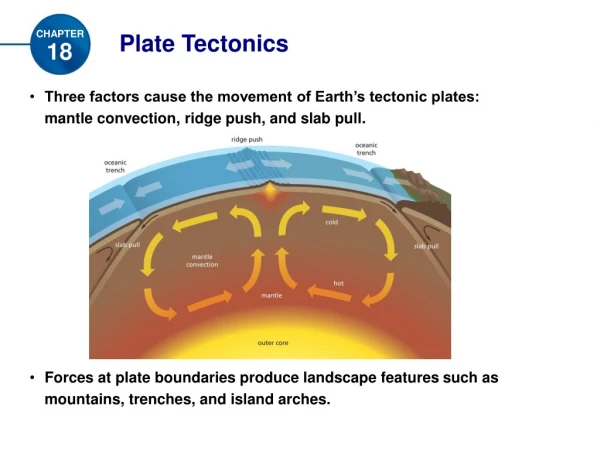
Theevolution of platetectonics • Original orclassicexplanation: • Convectioncurrentin theasthenosphere cause tectonicplatemovement. Currents are generatedbydifferences in density (temperatures9 • Lithospherefloatsontheasthenosphere • Wherehotcurrentsascend and separate, ridges are formed. • Wherecurrentscool and descend, trenches are formed.
Evolution of platetectonics • Currentexplanation: • Theasthenosphereisnottheonly place wherconvectioncurrentshavebeendetected: • belowsubductionzones • Hot spots of mantle(occasionally) In additiontoconvectioncurrents, there are twoforceswhich cause movement in thelithosphere: • Force of gravitypullsdownbothsides of elelvatedringes • Once a plateisbeingsubducted, theweight of sinkingplatespullsitdownlower.