Ionic and Covalent Compounds: Naming and Formulas Explained
160 likes | 434 Views
Learn how to name and write formulas for ionic compounds and covalent molecules. Understand multivalent metals and polyatomic ions. Practice naming simple covalent compounds with prefixes.


Ionic and Covalent Compounds: Naming and Formulas Explained
E N D
Presentation Transcript
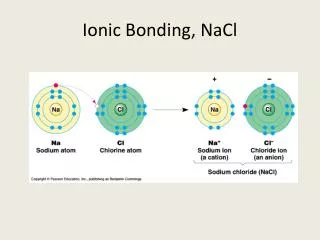
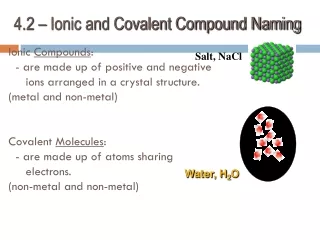
Ionic Compounds: - are made up of positive and negative ions arranged in a crystal structure.(metal and non-metal)Covalent Molecules: - are made up of atoms sharing electrons.(non-metal and non-metal) 4.2 – Ionic and Covalent Compound Naming Salt, NaCl Water, H2O
Naming Ionic Compounds: • name of an ionic compound = positive ion negative ion-ide • Ex.1: magnesium and oxygen • positive ion negative ion-ide • Magnesium ox + ide • Magnesium oxide • Ex.2: what is the name of Ca3N2? • Ca = calcium; N = nitrogen • Drop the end of the negative ion and add –ide • Calcium nitride • Ex.3: What is the name of BaCl2? • Barium chloride Magnesium oxide is used as a drying agent.
Writing formulas for Ionic Compounds Remember: positive charges must = negative charges Ex.1: What is the formula for magnesium phosphide? • Magnesium is Mg2+ Phosphorous is P3– • Lowest common multiple of 2 and 3 is 6 • 3 Mg2+ ions & 2 P3– ions (6 +ve’s & 6 –ve’s) • Magnesium phosphide = Mg3P2 • Ex.2: What is the formula for calcium oxide? Calcium is Ca2+ Oxygen is O2– 1 Ca2+ ion & 1 O2– ion Calcium oxide = CaO
Drawing Formula Diagrams • More Examples: • Lithium nitride • Barium sulphide
Ionic Compound with a Multivalent Metal • Multivalent: some transition metals have more than one charge. • Roman numerals are used after the metal name to indicate which ion was used Ex. 1 What is the formula manganese(III) sulphide? • This manganese is Mn3+ Sulphur is S2– • Lowest common multiple of 3 and 2 is 6 • 2 Mn3+ ions and 3 S2– ions • Mn2S3
You try! What is the name for TiF4? • Titanium can be Ti4+ orTi3+ Fluorine is F– • From the ratio in the formula you can find out it is Ti4+ • 1 Ti4+ ion and 4 F– ions • Titanium (IV) fluoride
Polyatomic Ions • are made up of several atoms joined together by covalent bonds • The whole group has a + or – charge, not individual atoms. • Ex.1 What is the formula of sodium sulphate? Na+ and SO42– Na2SO4
Ex.2: What is the name of the compound KClO? K+ = potassium ClO– = hypochlorite Potassium hypochlorite Ex.3: What is the formula for Calcium nitrate? Ca2+ and NO3- Ca(NO3)2 * Note the brackets around NO3 show there are two of the nitrate ions present
Naming Simple Covalent Compounds • Prefixes are used before the atom name to indicate the number of atoms in the molecule. • Examples: CO = carbon monoxide CO2 = carbon dioxide • Write the most metallic atom (furthest left) first, then add -ide to the end of the second atom’s name
Examples: • What is the name of the molecule Si3P6? • Trisiliconhexaphosphide • What is the chemical formula for the molecule trinitrogen tetrachloride? • N3Cl4
How do you know which type it is? • To determine whether a compound is ionic or covalent: - Examine the formula • Ionic compounds start with a metal or the ammonium ion • Covalent compounds start with a non-metal Take the Section 4.2 Quiz