Warm UP
130 likes | 295 Views
This lesson focuses on the intrinsic properties of parallelograms, characterized as quadrilaterals with both pairs of opposite sides parallel. Students will explore the unique properties of parallelograms through hands-on activities, including measuring sides and angles, and understanding the relationships between angles and diagonals. Key topics include the congruence of opposite sides and angles, supplementary consecutive angles, and the bisecting nature of diagonals. Engage in exploration and apply theorems to reinforce understanding of these geometric shapes.


Warm UP
E N D
Presentation Transcript
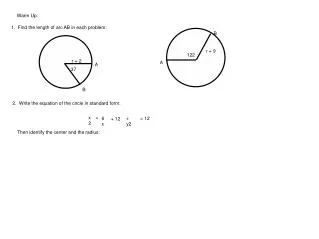
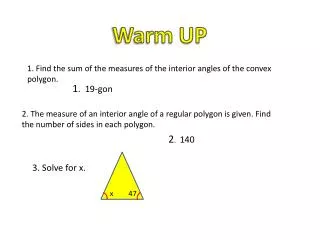
Warm UP 1. Find the sum of the measures of the interior angles of the convex polygon. 1. 19-gon 2. The measure of an interior angle of a regular polygon is given. Find the number of sides in each polygon. 2. 140 3. Solve for x. x 47
What is a Parallelogram? A parallelogram is a quadrilateral with both pairs of opposite sides parallel.
What makes a parallelogram special? Lets explore its properties…
Parallelogram Exploration • Mark a point somewhere along the bottom edge of your index card. • Connect that point to the top right corner of the index card to form a triangle.
Parallelogram Exploration • Cut along the line to remove the triangle. • Attach the triangle to the left side of the rectangle. • What shape have you created? Parallelogram
Parallelogram Exploration • Measure the lengths of the sides of your parallelogram. • Measure the angles of your parallelogram. • Add together your consecutive angles. What do you notice? Parallelogram
Theorem 8.3: If a quadrilateral is a parallelogram, then its opposite sides are congruent. Q R Theorem 8.4: If a quadrilateral is a parallelogram, then its opposite angles are congruent. P S
Theorem 8.5: If a quadrilateral is a parallelogram, then its consecutive angles are supplementary. Q R Why its true… P S
Parallelogram Exploration • Draw both of the diagonals of your parallelogram. • Measure the distance from each corner to the point where the diagonals intersect (point M). M What do you notice?
Theorem 8.6: If a quadrilateral is a parallelogram, then its diagonals bisect each other. Q R M P S
On the back of your parallelogram write the following Properties of a Parallelogram Both pairs of opposite sides are parallel Opposite sides are congruent Opposite angles are congruent Consecutive angles are supplementary Diagonals bisect each other