Download
1 / 1
10 likes | 140 Views
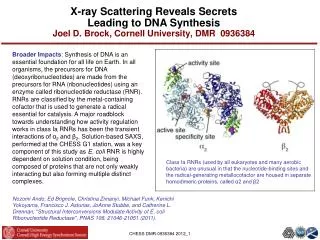
DNA synthesis is fundamental to all life on Earth, with ribonucleotide reductase (RNR) playing a crucial role. RNR converts ribonucleotides into deoxyribonucleotides, essential for DNA creation. This study, utilizing solution-based small-angle X-ray scattering (SAXS) at Cornell's CHESS facility, explores the transient interactions between the α2 and β2 components of Class Ia RNR in E. coli. Understanding these interactions is vital for unraveling the regulatory mechanisms of RNR, which is essential for all eukaryotic organisms and many bacteria.

E N D
X-ray Scattering Reveals Secrets Leading to DNA SynthesisJoel D. Brock, Cornell University, DMR 0936384 Broader Impacts: Synthesis of DNA is an essential foundation for all life on Earth. In all organisms, the precursors for DNA (deoxyribonucleotides) are made from the precursors for RNA (ribonucleotides) using an enzyme called ribonucleotide reductase (RNR). RNRs are classified by the metal-containing cofactor that is used to generate a radical essential for catalysis. A major roadblock towards understanding how activity regulation works in class Ia RNRs has been the transient interactions of α2 and β2. Solution-based SAXS, performed at the CHESS G1 station, was a key component of this study as E. coli RNR is highly dependent on solution condition, being composed of proteins that are not only weakly interacting but also forming multiple distinct complexes. Class Ia RNRs (used by all eukaryotes and many aerobic bacteria) are unusual in that the nucleotide-binding sites and the radical-generating metallocofactor are housed in separate homodimeric proteins, called α2 and β2 Nozomi Ando, Ed Brignole, Christina Zimanyi, Michael Funk, Kenichi Yokoyama, Francisco J. Asturias, JoAnne Stubbe, and Catherine L. Drennan; "Structural Interconversions Modulate Activity of E. coli Ribonucleotide Reductase", PNAS 108, 21046-21051 (2011). CHESS DMR-0936384 2012_1