Download
1 / 3
30 likes | 163 Views
This guide provides essential tips for optimizing VASP calculations on the CRC. It covers critical settings like adjusting NPAR to match the number of cores used, demonstrating significant differences in wallclock times between different NPAR settings. Additionally, it discusses the advantages of using local scratch directories over AFS, presenting comparative run times. The guide also includes strategic tricks for efficient KPOINTS usage, adapting cutoff energies for specific calculations, and selecting the appropriate ionic relaxation algorithm. Accelerate your VASP runs with these practical insights.

E N D
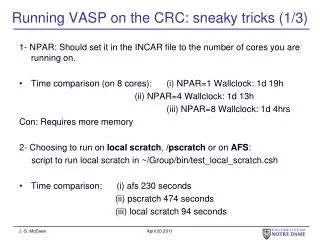
Running VASP on the CRC: sneaky tricks (1/3) 1- NPAR: Should set it in the INCAR file to the number of cores you are running on. • Time comparison (on 8 cores): (i) NPAR=1 Wallclock: 1d 19h (ii) NPAR=4 Wallclock: 1d 13h (iii) NPAR=8 Wallclock: 1d 4hrs Con: Requires more memory 2- Choosing to run on local scratch, /pscratchor on AFS: script to run local scratch in ~/Group/bin/test_local_scratch.csh • Time comparison: (i) afs 230 seconds (ii) pscratch 474 seconds (iii) local scratch 94 seconds April 20 2011
Running VASP on the CRC: sneaky tricks (2/3) 3- Doing a run for a small number of KPOINTS, copy CONTCAR to POSCAR and rerun for a high number of KPOINTS (trick done used by vasp team). • Most of the ionic steps (a factor of at least 10, much more for NEB calculations) will be done with the with the small number of KPOINTS: • e.g. (2x2x1) and then (8x8x1) for a (2x2) unit cell. • Can be done automatically in a script: April 20 2011
Running VASP on the CRC: sneaky tricks (3/3) 4- If only interested in the adsorption of O, can use a small cutoff (250 eV) for adsorption energy on metal, but hard (700 eV) “pseudopotential” for dissociation of a molecule in gas phase. 5- Choose the appropriate the proper ionic relaxation algorithm (read the sessions on ionic relaxation, see VASP wiki on the CRC, especially p.25). April 20 2011