Download

1 / 37
370 likes | 465 Views
Delve into the basics of biology for CS262 with an overview of biomolecules, gene functions, and regulatory processes. Explore the structures of DNA and RNA, the role of nucleotides, and the composition of proteins. Understand the flow of information from DNA to proteins through transcription and translation. Discover the genetic code, mRNA synthesis, and tRNA function. Learn about genes, genomes, and the central dogma of molecular biology. Gain insights into gene regulation, including the role of regulatory sequences in turning genes on and off.

E N D
Basic Biology for CS262 OMKAR DESHPANDE (TA)
Overview • Structures of biomolecules • How does DNA function? • What is a gene? • How are genes regulated?
Nucleic acids (DNA and RNA) • Form the genetic material of all living organisms. • Found mainly in the nucleus of a cell (hence “nucleic”) • Contain phosphoric acid as a component (hence “acid”) • They are made up of nucleotides.
Nucleotides • A nucleotide has 3 components • Sugar (ribose in RNA, deoxyribose in DNA) • Phosphoric acid • Nitrogen base • Adenine (A) • Guanine (G) • Cytosine (C) • Thymine (T) or Uracil (U)
Nitrogenous Base Nitrogenous Base Phosphate Group Phosphate Group Sugar Sugar Nucleotides
A A T G G C C C G G G C A A T C C G U A T G G C DNA RNA A = T G = C T U
Proteins • Composed of a chain of amino acids. R | H2N--C--COOH | H 20 possible groups
Proteins R R | | H2N--C--COOH H2N--C--COOH | | H H
Dipeptide This is a peptide bond R O R | II | H2N--C--C--NH--C--COOH | | H H
Protein structure • Linear sequence of amino acids folds to form a complex 3-D structure. • The structure of a protein is intimately connected to its function.
DNA in action • Questions about DNA as the carrier of genetic information: • How is the information stored in DNA? • How is the stored information used ? • Answers: • Information is stored as nucleotide sequences. • .. and used in protein synthesis.
The need for an intermediary • Fact 1 : Ribosomes are the sites of protein synthesis. • Fact 2 : Ribosomes are found in the cytoplasm.
The need for an intermediary • Fact 1 : Ribosomes are the sites of protein synthesis. • Fact 2 : Ribosomes are found in the cytoplasm. • Question : How does information ‘flow’ from DNA to protein?
The Intermediary • Ribonucleic acid (RNA) is the “messenger”. • The “messenger RNA” (mRNA) can be synthesized on a DNA template. • Information is copied (transcribed) from one strand of DNA to mRNA. (TRANSCRIPTION)
Next question… • How do I interpret the information carried by mRNA? • Think of the sequence as a sequence of “triplets”. • Think of AUGCCGGGAGUAUAG as AUG-CCG-GGA-GUA-UAG. • Each triplet (codon) maps to an amino acid.
The Genetic Code • f : codon amino acid • 1968 Nobel Prize in medicine – Nirenberg and Khorana • Important – The genetic code is universal! • It is also redundant / degenerate.
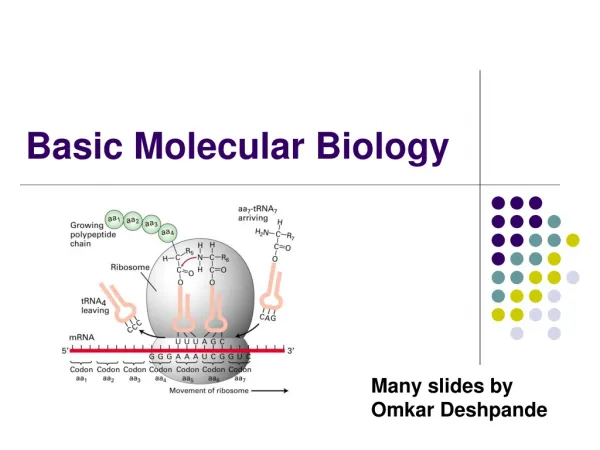
Translation • The sequence of codons is translated to a sequence of amino acids. • Transfer RNA (tRNA) – a different type of RNA – matches amino acids to codons in mRNA. • Freely float in the cytoplasm. • Every amino acid has its own type of tRNA that binds to it alone. • Anti-codon – codon binding crucial. • Show animation
The gene and the genome • A sequence of nucleotides on the DNA that encodes a polypeptide is called a gene. • Genome = Set of all genes in the organism + junk stuff (the entire DNA content).
More complexity • The RNA message is sometimes “edited”. • Exons are nucleotide segments whose codons will be expressed. • Introns are intervening segments (genetic gibberish) that are snipped out. • Exons are splicedtogether to form mRNA.
Splicing frgjjthissentencehjfmkcontainsjunkelm thissentencecontainsjunk
Central Dogma of Molecular Biology • DNA RNA Protein Phenotype • Transcription : DNA RNA • Translation : RNA Protein
Central dogma ZOOM IN tRNA transcription DNA rRNA snRNA translation POLYPEPTIDE mRNA
Transcription – key steps • Initiation • Elongation • Termination DNA
Transcription – key steps • Initiation • Elongation • Termination DNA
Transcription – key steps • Initiation • Elongation • Termination DNA DNA + RNA
Promoters • Promoters are sequences in the DNA just upstream of transcripts that define the sites of initiation. • The role of the promoter is to attract RNA polymerase to the correct start site so transcription can be initiated. 5’ 3’ Promoter
Genes can be switched on and off • In an adult multicellular organism, there is a wide variety of cell types seen in the adult. eg, muscle, nerve and blood cells. • The different cell types contain the same DNA though. • This differentiation arises because different cell types express different genes.
Regulation of genes • What turns genes on and off? • When is a gene turned on or off? • Where (in which cells) is a gene turned on? • How many copies of the gene product are produced?
Regulatory sequences • These are binding sites for proteins, often short stretches of DNA (~25 nucleotides). • Inexactly repeating patterns (“motifs”). • Motifs stand out as highly conserved regions in a multiple sequence alignment.
Acknowledgments • Martin Tompa, for a couple of slides on gene regulation • vector.cshl.org/dnaftb/ for the tRNA figures, and the protein synthesis animation • Russ Altmann, for the figure on “Bioinformatics Schematic of a Cell”