Download
1 / 11
110 likes | 236 Views
This presentation by Donald Brady at the Western Regional Meeting on May 19, 2010, discusses critical aspects of managing endangered species through the implementation of Biological Opinions (BiOps) by the National Marine Fisheries Service (NMFS). It highlights strategies for labeling and bulletin development to enforce pesticide use limitations, the impact of three organophosphate and N-methyl carbamate pesticides, and future bulletins under the NMFS settlement agreement. Key data sources and methodologies for monitoring pesticide impacts on species are also reviewed.

E N D
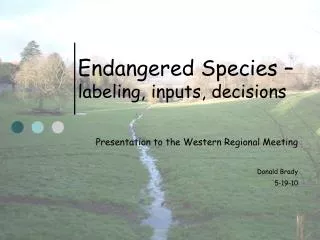
Endangered Species – labeling, inputs, decisions Presentation to the Western Regional Meeting Donald Brady 5-19-10
Topics • Biological opinions from NMFS • Upcoming • Issued • Labeling and Bulletins Live! • Bulletins Live Two (BLT) • Data sources and information
Implementation of First Two NMFS BiOps • Three organophosphate pesticides • Provided draft bulletins for review by affected regions, states and tribes; growers; registrants. • Considered comment and finalized bulletins • April 29, 2010 – EPA letter to registrants • May 7, 2010 – response from registrants • They will not implement the measures voluntarily • Three N-methyl carbamate pesticides • EPA informed NMFS how we intend to implement the BiOp in a letter dated May 14, 2010. • Will develop bulletins and provide to affected regions, states, tribes and registrants • Will follow similar course as first biop
Labeling and Bulletins Live! • Bulletins Live! will provide enforceable use limitations relative to endangered species. • Schedule for posting bulletins to that site will depend on: • Bulletins being developed • Product carrying generic label statement referencing Bulletins Live! 5
Labeling and Bulletins Live! • User selects • State and county of pesticide use • Month in which application will be made • Bulletins Live! produces Endangered Species Protection Bulletin showing areas where further limitations apply and what those limitations are 6
Bulletins Live! Two (BLT) • In development • Interactive mapper (such as bing maps or google earth) • Not county based • Geocoded so you can key in location • Bulletins will be based on specific geography into which the user zooms. 7
Guideline studies Public literature Monitoring data State use and usage data Service listing notices Service web site for critical habitat and IPAC system info FESTF element occurrence data GESTF land use data (future) Data Sources and Information PESTICIDE SPECIES 8
Guideline studies Public literature Monitoring data State use and usage data Conducted well, specific to pesticide, end points Potentially on more sensitive spp but methodology not always transparent and not always targeted to the pesticide Useful but tells only what was there when the sample was taken Useful for characterizing extent of use and usage Data Sources and Information PESTICIDE STRENGTH/WEAKNESS 9
Difficult to interpret and often no spatial component Limited critical habitat and location information in the system to date and Service continues to say the written descriptions are the legally defined areas. Based on Nature Serve which captures “sightings”. System currently does not allow EPA to manipulate spatial data. In development but will, among other things, provide refined land cover data for several land classes. Data Sources and Information STRENGTH/WEAKNESS SPECIES • Service listing notices • Service web site for critical habitat and IPAC system info • FESTF element occurrence data • GESTF land use data (future) 10