Download
1 / 21
210 likes | 306 Views
Learn about direct CP violation and charmless decays analyzed by the University of Liverpool in collaboration with BABAR. Results include measurements of branching fractions and CP asymmetries in various B meson decays.

E N D
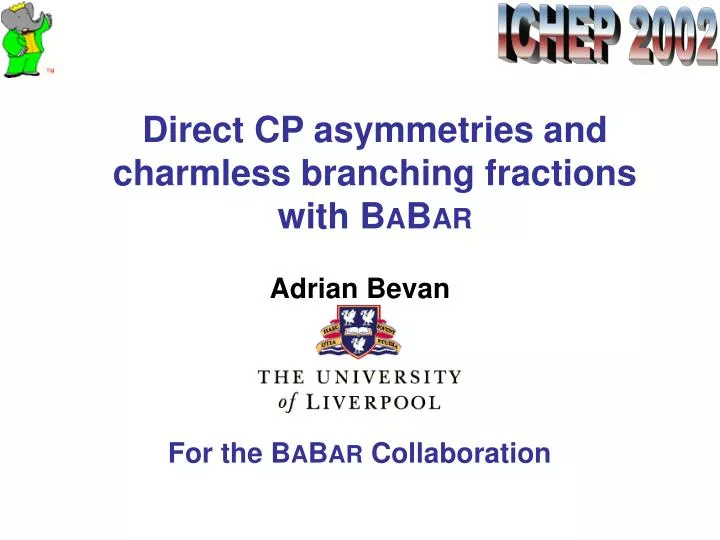
ICHEP 2002 Direct CP asymmetries and charmless branching fractionswith BABAR Adrian Bevan For the BABAR Collaboration
g Overview • Motivation: Direct CP Violation (CPV) New Physics sensitivity e.g. XSg, fK Penguins • Event SelectionMethods • Results: Charmless decays, K*g, D0CPK- • Summary and outlook University of Liverpool
direct CPV Direct CP Violation • need interference between diagrams with different strong (i) and weak phases (i) : • Direct CPV only seen in ; ' ~ few 10-6 • theory predicts large asymmetries in B+/0(few to 80%) • Diagrams from New Physics (e.g. SUSY) can modify SM asymmetries/branching fractions University of Liverpool
direct CPV • Experimentally - look for CP asymmetries: • Neutral B – time dependent asymmetry • Charged B – time integrated asymmetry (no mixing); also used for some B0 results (e.g. K0p0) C≠0 direct CPV; e.g. for , pp … University of Liverpool
Searching for direct CPV • Large ACP requires amplitudes of similar order • b→u: suppressed tree: charmless decays • large predicted ACP • b→s,d: penguins: radiative decays • small predicted ACP • Understand penguins • Access to a and g • Sensitive to New Physics effects via loops • minimal SUGRA: B→Xs, K+, K0+ … • R-parity Violating SUSY: KS … • SUSY searches – K* University of Liverpool
Experimental Issues • small branching fractions • large continuum background (u,d,s,c) • other B background • charge bias • detector: trigger, tracking; reconstruction • event selection, particle ID, analysis • Proof of principle • ACP in J/yp, J/yK PRD 65 091101 (2002) • AJ/y = 0.01 0.22 0.01 • AJ/yK = 0.003 0.030 0.004 small systematic error: few per mille University of Liverpool
signal MESs ~ 3 MeV B background Event Selection Techniques Use beam energy to constrain mass & energy DE s ~ 15-80 MeV; larger with neutrals University of Liverpool
u,d,s,c u,d,s,c background Signal Arbitrary Units B event Fisher Discriminant Event Selection Techniques B events are spherical u,d,s,c is jet-like • Fisher Discriminants • Thrust • Sphericity • Fox-Wolfram moments • flavour-tagging (e, , K, slow from other B) • Maximum Likelihood fits or cut based analysis • off-resonance & E sidebands are used to parameterise light quark background University of Liverpool
RESULTS University of Liverpool
B→K+p0 B→K+p- Two body decays can measure eg. B→+-, +0, 00 eg. B→K+-, K0+ using Fleischer Mannel bound ACP can be sizeable see Jim Olsen’s talk Plots have an optimised cut on likelihood ratio University of Liverpool
5% DACP New results ~88106 B pairs Preliminary ~60106 B pairs hep-ex/0206053 All upper limits are @ 90% C.L. University of Liverpool
light q background data B background bin efficiency B→hhh, h=, K Motivation • measure using a full Dalitz plot • look for direct CPV in charge asymmetry Method • cut based analysis across the Dalitz plot for branching ratio: sum over Dalitz plot • B backgrounds: J/K, D/DK, X-feed; D→, K, KK • subtract open charm from J/, (2s) and D0 • measure Br(B-→D0p-)as a cross check University of Liverpool
B→KKK B→KKK Preliminary B→Kpp D0 B→Kpp BB y(2s) J/y University of Liverpool
56.2106 B pairs Branching fractions measured across the Dalitz plot (90% C.L.) (90% C.L.) • Main systematic uncertainties • PID 3 ~ 6% • tracking 2.4% Preliminary University of Liverpool
B+→K+ Events / (0.0025 GeV/c2) (→pp, rp) MES (GeV/c2) B→K(*), K, sensitive to sensitive to ,g • B→K(*), suppressed tree; ACP 4~30% (theory) • B→K, , penguin; ACP ~6% (theory) preliminary PRD 65 (2002) 051101 University of Liverpool
Signal yield = events DE (GeV) MES (GeV/c2) Preliminary ~60106 B pairs B0→wK0 First Observation! 6.6 s significance (statistical) • penguin • sensitive to a, g • expect small ACP • ML fit • dominant systematic • uncertainty: • background shape • neutral eff • tracking Signal region University of Liverpool
fK+ N(B→K+) / 2 MeV B→K(*), Motivation: • ACP~2% in SM • New Physics (ACPup to 30%) • sin2 if no new physics see Doug Wright’s talk PRD 65 (2002) 051101 PRL 87 151801 (2001) University of Liverpool preliminary
see Erich Varnes’ talk B-→D0(CP)K- • ACP may be large • access to g • Doreconstructed: • in Kp, Kppo, Kppp • in K+K- (CP=+1 eigenstate) Preliminary University of Liverpool
~22.7106 B pairs B →K* Phys Rev Lett 88 101805 (2002) • Acp≤1% in SM. • SUSY can enhance to ~20% Reconstruct ACP(B→K*)= -0.044 0.076 0.012 [-0.170, 0.082] (90% C.L.) University of Liverpool
continuum B-background total fit B0→+- ~88106 B pairs Other results: see talk on a • via isospin analysis and direct CPV from time evolution of B→ +- Cpp= -0.30 0.25 0.03 Spp = 0.02 0.34 0.03 Factorization predicts 0.4 Br(B0→p+p-)=(4.6 0.6 0.2)10-6 Br(B+→p+p0) =(5.5 1.00.6)10-6 Br(B0→p0p0) < 3.6 10-6 Preliminary University of Liverpool
Summary and outlook • First CP results from B0→ • Branching fractions and ACPmeasured in many decays • ACP precision achieved 5~20% • No direct CPV signal yet … • watch for future updates University of Liverpool