Understanding Energy and Natural Resources: Definitions, Types, and Future Challenges
Energy is defined as the ability to do work, a fundamental concept in both natural and human activities. Our natural resources are classified into renewable and non-renewable types. Renewable resources, like water, plants, and soil, can be replenished but can also be depleted through human activities. In contrast, non-renewable resources, such as fossil fuels and minerals, exist in finite quantities. As global competition for energy resources increases, understanding sustainable practices, like recycling and the potential of nuclear and alternative energy sources, becomes critical for a sustainable future.

Understanding Energy and Natural Resources: Definitions, Types, and Future Challenges
E N D
Presentation Transcript
What is energy? • What do you think of? • What is the definition? • The ability to do work, or the cause of all activity
Natural Resources • Renewable- • can be replaced by people or by the Earth • Water, plants, animals, soil,etc. • Can be depleted faster than they are replenished • Renewal can be effected by human activities • replanting trees, wildlife preserves, clean air and water laws • oil spills, deforestation, over-building
Non-Renewable Resources • The Sun- will run out….in about 5 billion years • Minerals formed in the Earth’s crust – millions of years to reform • Iron, gold, uranium, etc. • Recycling can help to delay the disappearance of these • Fossil Fuels- coal, oil, and natural gas • Formed from the remains of ancient plants and animals
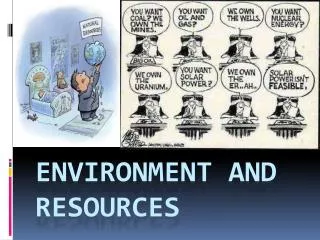
Energy Sources • Competition for resources has defined the survival of species. • This competition has become maybe THE strongest factor in politics and economics
Fossil Fuels • Most nations depend heavily on oil • most do not have enough supply to match this demand and so must import. • Over 60% of the world’s supply of oil and natural gas • concentrated in a few countries in the Middle East and N. Africa
The End of Oil • The world’s known oil reserves will only last another 50 years or so • There are unproven reserves, but tapping those sources may have environmental drawbacks • Natural Gas and Coal are also nearing the end. • About 200 years left for coal
Nuclear Energy • Fission- splitting of uranium atoms in a nuclear reactor, releasing their stored energy • Pro’s • Does not pollute • Creates a great deal of energy • Cons • Leaks, explosions, and disposal of radioactive material • Refining uranium DOES pollute
Can Nuclear energy be used? • Hope to find a way to generate energy through Fusion, the combining of atoms • No chance of meltdown, no pollution, waste is short-lived • Could provide energy for millions of years • Technology does not yet exist (Possibly by 2050)
Other Energy Sources • Water • Falling water creates energy to move machinery • Oceanic tides can be used as well • Geothermal • Energy from the Earth’s internal heat creating steam • Hot springs and geysers would only last a few decades
Solar • Converting the Sun’s rays to electricity • More technology is needed to make it practical • Wind • Clean, renewable resource • How much energy? • “noise pollution”
Brainstorm • In what ways do you (or have you) used renewable resources?