Download
1 / 31
310 likes | 422 Views
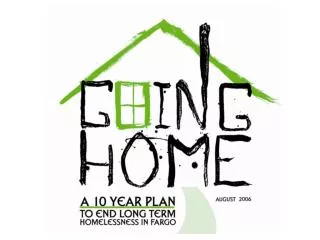
To end long term homelessness in Fargo…. Identify housing and service supports for 224 households . Create a demand-based model that offers the housing options our target tenants want – not the one we think they need. Fargo Long-term homeless. Who are the target tenants?.

E N D
To end long term homelessness in Fargo… • Identify housing and service supports for 224 households. • Create a demand-based model that offers the housing options our target tenants want – not the one we think they need.
Addressing Root Causes – Why are the community’s long term homeless in a “housing crisis”? • Unable to pay for housing • Low wage job • Unemployable/ed due to disability • Unable to stay housed • Substance abuse • Mental illness with inconsistent use of meds • Unable to access housing • Criminal background • Poor credit • Poor rental history • Uninterested in engaging with the system as currently defined • Following the rules
7 Strategies in “Going Home” • Increase availability of permanent supportive housing • Improve consumers’ ability to pay for housing • Develop partnerships that will move people in to housing first • Make outreach to long term homeless more effective • Stop discharging people into homelessness • Enhance the coordination and availability of prevention services • Collect data and share info about homelessness
Strategy #1: Increase the availability of permanent supportive housing • Identify landlords willing to rent to LTH individuals • Take concrete steps to mitigate the perceived risk of renting to LTH • Indemnification Fund • Co-sign Leases • 24 hour crisis line • Inject flexibility in lease terms when possible • Convert existing shelter beds to PSH • Establish new safe haven housing • Encourage creation of new affordable efficiency units
Strategy #2: Improve consumers’ ability to pay for housing • Add more housing vouchers to local system • S+C • Tenant-based rental assistance • Section 8 (thru rule mod) • Targeted employment placement specialists • Expand network of people who can help with benefit eligibility • Subsidize additional rep payee services • Transitional Jobs program
Strategy #3: Develop partnerships that will move people into housing first • Support creation of IDDT at SEHSC • Enhance service connections for veterans • Expand informal group case mgmt approach • Establish peer mentor system to supplement case mgmt work • Establish “Fresh Start” fund • Create metro homelessness ombudsman
Strategy #4: Make outreach to LTH more effective • Establish fund to support outreach workers’ relationship building activities • Initiate “Project Homeless Connect” • Support consumer-operated drop-in center
Strategy #5: Stop discharging people into homelessness • Connect health care providers with housing resources to minimize discharge to streets • Implement post-booking diversion program (JICC) • Support efforts to bolster discharge planning at state institutions • Support DOCR Re-entry initiatives
Strategy #6: Enhance the coordination and availability of prevention services • Guide to rent assistance • Community homelessness prevention strategy • Landlord/tenant mediation • Increased intensity of prevention service for most at-risk • Communication between landlords and prevention workers about effective prevention techniques
Strategy #7: Collect data and share information about homelessness in metro area • Increase use of HMIS • Support survey efforts • Community awareness • Document community costs • Integrate definition of long term homelessness into data collection practices
Who can make this more than just a Plan? • City of Fargo • Fargo Housing Authority • FM Homeless Coalition • Local agencies • ND Homeless Coalition • State of ND (Corrections, Job Service, SEHSC, District Ct)
Leadership - City • Coordinate Plan implementation, steering committee and partner recruitment, community outreach • Develop local tenant-based rental assistance program • Develop Landlord/Tenant mediation program • Encourage affordable/mixed income housing development • Data collection technical assistance and funding, including community costs and baseline information
Leadership – FM Homeless Coalition • Local Homelessness Ombudsman • Project “Homeless Connect” • Connect health care providers with local resources • Guide to Rent Assistance • Community Homelessness Prevention strategy • Develop information for coordinated community message
Leadership – Fargo Housing Authority • Landlord recruitment / coordination • Management of locally available rent subsidies (S+C, TBRA, Sec 8) • Manage “Fresh Start” fund
Leadership – Other local • SENDCAA – Landlord/tenant mediation • Presentation Partners – intense emergency assistance for at-risk families • Ray of Hope – Peer mentor system, consumer-operated drop in center • YWCA and New Life Ctr - Conversion of shelter beds to PSH • Mental Health Assoc – Post booking diversion program • Community assistance provider network – communication b/t prevention & landlords
Leadership – ND Homeless Coalition • Mainstream resource eligibility coordination • Institutional discharge planning • Increasing utilization and usability of HMIS
Leadership - State • Dept of Corrections Re-entry and TPCI programs • Integrated Dual Disorder Treatment team at SEHSC • Connections between Dept of Human Services and VA • Employment Specialists (Job Svc) • Homeless Mgmt Information System (HMIS)
…plus State Support • Landlord/Tenant Mediation program (Dist Ct system) • Tenant-based rental assistance program • Risk Mitigation Fund • Jail Intervention Coordinating Committee Post-booking diversion program • Encourage mixed income projects with LIHTC program
Leadership – TBD • 24-hour crisis line • Flexible property management practices • Provider ability to co-sign leases • Safe haven housing development • Employment placement programs • Transitional Jobs program • Development of Rep payee svcs • Outreach workers’ fund
Risk Mitigation Fund Safe Haven housing Rent subsidies Employment programs IDDT service team Corrections programs (re-entry, diversion programs) Rep Payee Svc Fresh Start Fund Outreach workers’ fund Project Homeless Connect Guide to rent assistance Homelessness prevention strategy Increasingly intense emergency assistance to at-risk Most likely funding sources Private (Faith, Corp., Charitable) Public (Local, State, Federal) Both Public & Private • Conversion of Emerg. Shelter beds to Permanent housing • Affordable 0-BR market rate rentals • Local homelessness ombudsman • Drop-In Center • Landlord/tenant mediation • Data collection/ analysis/presentation of information