The Evolution of Life: From Prokaryotes to Eukaryotes and Beyond
This chapter explores the history of life on Earth, detailing the origins of life and the evolution of organisms from prokaryotes to eukaryotes. It discusses key milestones such as the emergence of the first single-celled organisms, the significance of stromatolites, and the development of multicellular life forms. Additionally, it addresses the phylogenetic shift from a two-kingdom classification to a three-domain system, encompassing Bacteria, Archaea, and Eukarya. This expansive overview highlights the diversity of life and the ancient ecosystems that have shaped our planet.

The Evolution of Life: From Prokaryotes to Eukaryotes and Beyond
E N D
Presentation Transcript
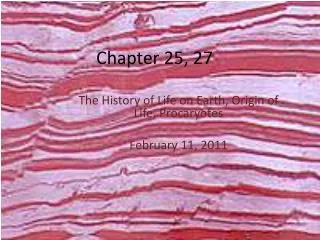
Chapter 25, 27 The History of Life on Earth, Origin of Life, Procaryotes February 11, 2011
eukaryotes EUKARYA Dinoflagellates Land plants Forams Green algae Ciliates Diatoms Red algae Amoebas Cellular slime molds Euglena Trypanosomes Animals Leishmania Fungi Sulfolobus Green nonsulfur bacteria Thermophiles (Mitochondrion) Spirochetes Chlamydia Halophiles COMMON ANCESTOR OF ALL LIFE Green sulfur bacteria BACTERIA Methanobacterium Cyanobacteria both are prokaryotic (Plastids, including chloroplasts) ARCHAEA
From Two Kingdoms to Three Domains • Recently, based on phylogenetic analysis: the three domain system has been adopted: the domains are Bacteria, Archaea, and Eukarya. • So how did it all start, how long ago did it start, and then what happened?
The First Single-Celled Organisms • The oldest known fossils are stromatolites, rock-like structures composed of many layers of bacteria and sediment • Stromatolites date back 3.5 billion years ago • Prokaryotes were Earth’s sole inhabitants from 3.5 to about 2.1 billion years ago
Fig. 25-4i Stromatolites
Fig. 25-4j Fossilized stromatolite
The oldest fossils, from the Australian rocks called the Apex Chert: And the Gunflint Chert, 1.9 billion yr old. From north of Lake Superior 3.5 billion yr old
Meteorite contents witness ancient non-biological organic molecules
including molecules that form osmotically functional vesicles Nonanoic acid Polycyclic aromatic hydrocarbons
Fig. 25-3 20 µm Glucose-phosphate Glucose-phosphate Phosphatase Starch Amylase Phosphate Maltose (a) Simple reproduction by liposomes Maltose (b) Simple metabolism
Fig. 25-7 Ceno- zoic Meso- zoic Humans Paleozoic Colonization of land Animals Origin of solar system and Earth 4 1 Proterozoic Archaean Prokaryotes years ago Billions of 3 2 Multicellular eukaryotes Single-celled eukaryotes Atmospheric oxygen
eukaryotes EUKARYA Dinoflagellates Land plants Forams Green algae Ciliates Diatoms Red algae Amoebas Cellular slime molds Euglena Trypanosomes Animals Leishmania Fungi Sulfolobus Green nonsulfur bacteria Thermophiles (Mitochondrion) Spirochetes Chlamydia Halophiles COMMON ANCESTOR OF ALL LIFE Green sulfur bacteria BACTERIA Methanobacterium Cyanobacteria both are prokaryotic (Plastids, including chloroplasts) ARCHAEA
Fig. 25-7 Ceno- zoic Meso- zoic Humans Paleozoic Colonization of land Animals Origin of solar system and Earth 4 1 Proterozoic Archaean Prokaryotes years ago Billions of 3 2 Multicellular eukaryotes Single-celled eukaryotes Atmospheric oxygen