Midterm 1 Breakdown
This breakdown provides an overview of Context-Free Grammars (CFGs) as part of the CS 3240 course on Languages and Computation. A grammar G is defined by a set of variables, terminal symbols, productions, and a start variable. Each CFG follows specific production rules that allow for generating valid strings in a language. By examining examples and derivations, students will explore how CFGs can express certain languages and compare them to regular languages. Exercises included will challenge students to design CFGs for various language sets.

Midterm 1 Breakdown
E N D
Presentation Transcript
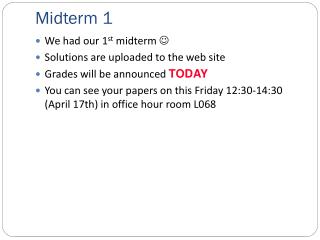
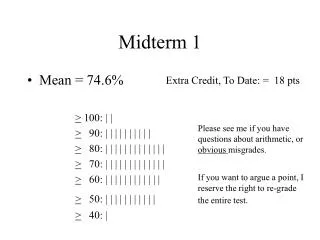
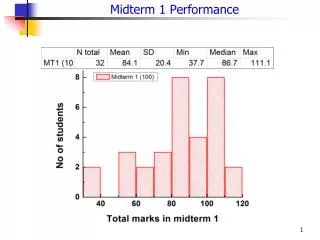
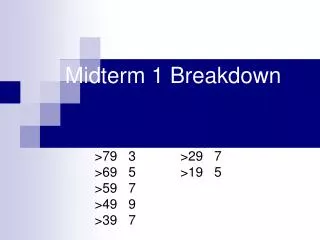
Midterm 1 Breakdown >79 3 >29 7 >69 5 >19 5 >59 7 >49 9 >39 7
CS 3240: Languages and Computation Context-Free Languages
What are Grammars? • A grammar G is defined by (V, T, P, S), where • V is a finite set of variables • Tis a finite set of terminal symbols • P is a finite set of productions or ules • SV is the special start variable • Each grammar G defines a language L(G), which is the set of strings in T* (=Σ*) that G can generate from S. • Automata are actuated by the transition table, grammars by the production rules.
Context-Free Grammars • A context-free grammar (V, T, P, S) is a grammar where all production rules are of the form: A → x, with AV and x(VT)*A string in (VT)* is called sentential form • E.g., let G = ({S}, {a,b}, P , S) with for P: • S→aSa • S→bSb • S→. • Some derivations from this grammar: • S aSa aaSaa aabSbaa aabbaa • S bSb baSab baab, and so on. • In general S …. wwR for w{a,b}*.
Another CFG Example Consider the CFG G=({S,Z},{0,1}, P, S) with P: S 0S1 | 0Z1 Z 0Z | What is the language generated by this G? Answer: L(G) = {0i1j | ij } Specifically, S yields the 0j+k1j according to:S 0S1 … 0jS1j 0jZ1j 0j0Z1j … 0j+kZ1j 0j+kε1j = 0j+k1j
Exercise • Design CFGs for the following languages: • { 0n1n : n≥0} • { 0n1m : n,m≥0} • { (0|1)* : # of 0s > # of 1s} • Answers: • S → 0S1 | • S → 0S | R and R → 1R | • S → T0T and T → TT | 0T1 | 1T0 | 0 |